




Think back to the last time you searched for something on Google, and actually clicked a link. If you can remember it, good luck. Even that's becoming less necessary. Just type your question, and the answer is there. Top of the box. Spoken back to you by your own personal (well, Google's personal) AI research assistant, which already read the entire Internet, in detail . It's not an accident. This is a fundamental revolution of how people find information on the Internet, and it is happening at a breakneck speed even most businesses haven't caught on. Search engines are far more than indexes now. They are reading, understanding and answering directly. If your brand isn't one of those answers, you're invisible to one of your most potential audiences. And that's where Answer Engine Optimization and this is the primer on that.
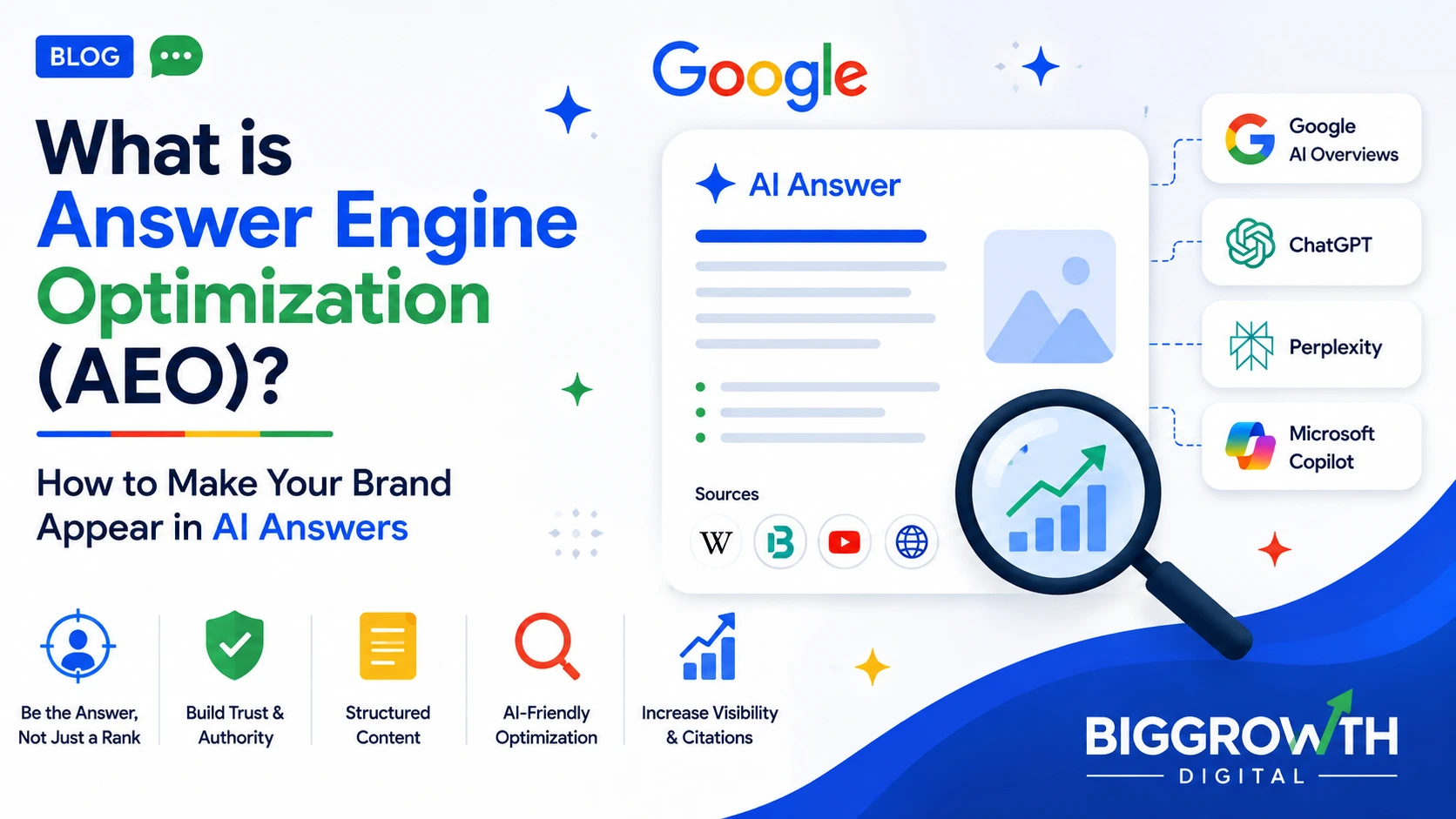
So what is Answer Engine Optimization (AEO)
Answer Engine Optimization, or AEO, is the method you use to write and organize your content in such a way that AI-powered search tools like ChatGPT, Perplexity AI, Google's AI Overviews, Microsoft Copilot and the like can find it, believe it and bring it to the top as an answer to a searcher's question. It used to be about ranking on a list.
AEO is about becoming the answer. When I fire up Perplexity AI and type in "Best real estate agent in South Delhi" or "where can I find a trustworthy mortgage broker in India" there is a computer making a decision about which person's content to cite, quote or summarize.
The machine isn't looking for the highest bid or the most backlinks. It's looking for the clearest, most credible, most contextually appropriate answer to the query. AEO is the practice of ensuring your brand's answer.
Here's the simplest way to think about it:
SEO uses the question that is posed to them: Can Google find the site and rank it favorably?
AEO enquires: Could an AI read, believe and recite the content on my page?
These are meaningfully different questions and they deserve meaningfully different responses.
AEO vs SEO in 2026: What's Actually Changed
This isn't about one weeding out the other. SEO is still kicking, it hasn't died, been abandoned, or rendered irrelevant. It's as vital and applicable as it's ever been. But the world of search today2026has shifted, even in the space of three years, and the distance between classic SEO and AEO tactics only increases each quarter. This shift began with the launch of Google AI Overviews, the LLM-powered summaries showing at the top of many results pages. It then coincided with the massive mainstream uptake of ChatGPT as a search tool.
Then followed Perplexity AI, which is explicitly billed as an answer engine (built around retrieval from the web). Microsoft Copilot was then integrated directly into browsers, enterprise software, and productivity tools. Each time, the nature of information retrieval was transformed, and the way content needed to be written changed.
In traditional SEO, you optimized to be crawled, to have the right keywords density, to have backlinks, to pass page authority -- you wanted to be on page one. In AEO, you optimize for understanding, for authority, for being directly answerable. You want the search engines to cite you within the answer or better, be the answer.
What separates the two in practice:
Search Engine Optimization optimizes the key terms' placement in connection with the originating website, the accessibility of the website, the relevance of the web page loaded because of the search and mostly how many links into the page you click.
AEO emphasizes on question and answer structure, correctness of facts, use of schema markup, trustworthiness of the source and the ability of an AI to extract a clean, trustworthy answer from your content.
SEO rewards content that ranks. AEO rewards content that answers.
In SEO, top 3 positioning is king. In AEO, getting mentioned in an AI-created summary, no clicks at all from the user, is all you need. AEO takes insight into how AI models read value that even Google's crawling, which has been used to rank for decades, can't provide.
The brands that are winning on brand visibility in the 2026 AI search are not always the ones with the heftiest SEO budget. They're the ones who put pen to paper like teachers, not marketers.
How to get your Brand into AI Answers? A simple AEO approach.
Not the theory, the actual step-by-step process. Here is a real AEO strategy built from what is currently working, not something that worked two years ago.
The number one change you could make that would produce the biggest results is to move from writing around your services to writing around your audience's questions. Not broad topics, narrowly defined questions.
Exactly the kind of things your clients literally ask the search engine or voice interface.
Leverage tools like AnswerThePublic, AlsoAsked, and the question filters in SEMrush to identify the very questions consumers are asking for in your niche.
Create dedicated pages or sections that just address 1 question well, not 2 or 3 questions on each page.
Use the question you are seeking the answer to as the H2 or H3 heading, and start the section by giving a straightforward, to the point answer in the very first section of text.
As you can see, AI engines grab the beginning of a section much more than anything in the middle.
More specific for the real estate brand: Provide answers to questions such as locations of circles, price brackets, good builders, legal process, market.
Optimize In particular for Perplexity AI
Perplexity AI has emerged as among the most relevant answer engines for research-leaning users. It contains a crawler/citation nature that you can optimize for. When you plan an AEO approach for Perplexity AI, the priorities are: Be indexable/linkable.
Perplexity cites sources.
If your site's have poor crawlability or block bots you'll never show up. Write knowing you can include citations.
Perplexity favors pages that cite data, studies, or primary sources where they'd like to think there's an honest node in the information network.
Choose simple straightforward statements that can be lifted directly from the text by the reader. Keep writing. Perplexity's recency bias h means a blog written today ranks higher than a page published three years back in rapidly advancing fields.
Establish topical authority. Perplexity as with any AI engine prefers sites which are authoritative on one product in one niche compared to more generalist websites that have only superficial coverage of every product.
Understand How to Appear in ChatGPT Answers
One of the most important questions right now in digital marketing is:How do I get to show up to a ChatGPT answer the answer is a bit more complex than people want to hear. ChatGPT's base model has a knowledge cut off, so most of your searches unless they're hyper-specificare going to be using ChatGPT!
It is a lengthy process to get your brand in the training data. The more your content is prominent across the web (not just on your own page, but in directories, articles forums, or 3rd-party sites in training data) the better. In contrast, the ChatGPT with web browsing (and the GPT-4 browsing plugins) will search for live content.
In this mode: These Perplexity principles are still valid: structured, convincing source newcontent goodcoverability. That your brand is getting spoken of and referenced by those whose opinion counts can be very important.
Third-party validation--a writeup in a trusted magazine, a referenced statistic, an expert quoted opinion--sends the model the message that your brand exists, is reliable, and deserves to be brought to users' attention.
Have a strong Wikipedia -style presence: clean factual citation dense pages about your brand / principles even if just on your own About.
The Brands That Get This Now Will Be Extremely Difficult To Catch Later
Search has always rewarded early movers. The brands that figured out SEO in 2003 built advantages that lasted a decade. The brands that master AEO in 2025 and 2026 will do the same. Because (whether we like it or not) AI answer engines, once they trust a source, will keep trusting it. What right now - In particular in India, Mostly in high-intention sectors like real estate - the opportunity is real, the opportunity is huge, and the opportunity is pressing.
You don't need to do everything at once. Begin by doing one thing: identify the ten questions your clients ask most often, take the time to prepare well-crafted truthful expert answers, organize them logically, and publish them. This will instantly put you ahead of 90% of your competitors.
AEO is not a gimmick. In the next ten years in search of more and more, will consumers view your brand as an integral part of the answer, or invisible in it?