




Reducing marketing costs doesn't always mean reducing the number of leads a business generates. Sometimes cutting ads can solve the wrong problem. If the campaigns are already bringing a good number of leads,
If your campaigns are already bringing in a healthy flow of leads, the smarter approach is to make every marketing rupee work harder.
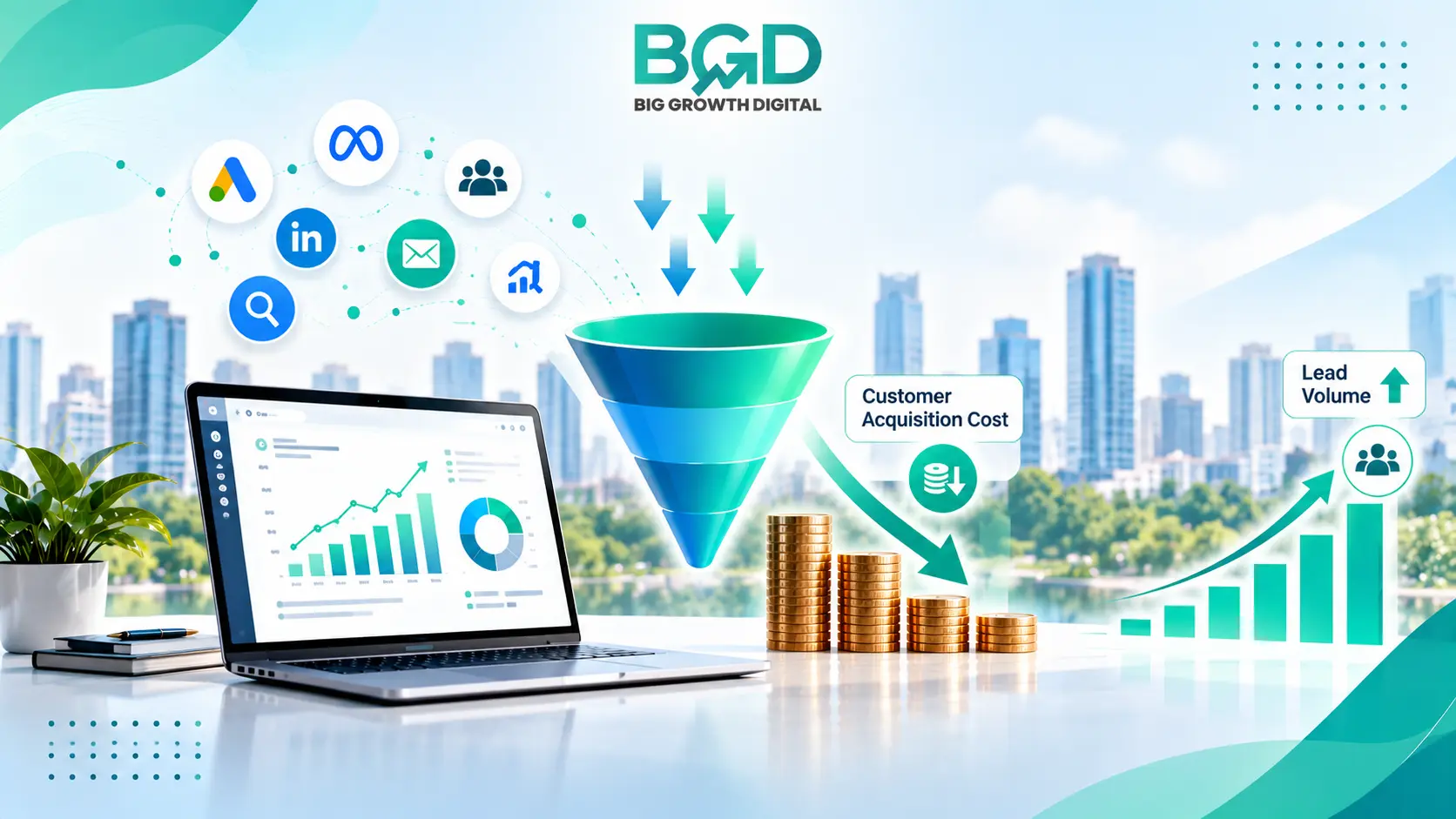
This is where customer acquisition cost becomes significant. A business can generate thousands of leads, but if it spends too much on converting them, CAC can rise. Improving lead quality, the conversion journey, creative strategy, and budget allocation can help businesses reduce CAC while maintaining lead volume. It is not required to spend less, but to acquire new customers from the same acquisition budget while protecting the quality of the customers. This blog will discuss how to reduce customer acquisition cost without cutting lead volume.
What Is Customer Acquisition Cost?
Customer acquisition cost (CAC) is the average amount a business spends to acquire one new customer. It considers the expenses involved in marketing and sales during a particular period and compares them with the number of new customers acquired during that same period.
The basic formula is:
Customer Acquisition Cost = Total Sales & Marketing Expenses ÷ Number of New Customers Acquired
For example, suppose a company spends ₹5,00,000 on marketing and sales in one month and acquires 100 new customers.
CAC = ₹5,00,000 ÷ 100 = ₹5,000
So, the customer acquisition cost is ₹5,000 per customer.
Depending on the purpose of the analysis, acquisition expenses can include advertising, sales salaries, commissions, marketing software, creative production, agencies, events and other relevant overheads.
Customer Acquisition Cost vs Cost Per Lead
These two metrics are related but not identical.
Metric | What it tells you | Basic calculation |
Cost Per Lead | Amount spent to generate one lead | Marketing spend ÷ Leads |
Customer Acquisition Cost | Amount spent to acquire one paying customer | Sales & marketing spend ÷ New customers |
Conversion Rate | Effective lead conversions | Customers ÷ Leads × 100 |
Customer Lifetime Value | Revenue generated by a customer over time | Customer value × Customer lifespan |
This distinction matters because cost per lead reduction alone does not guarantee lower customer acquisition cost.
Why Should You Reduce Customer Acquisition Cost?
A lower customer acquisition cost allows the business to get more value from its current marketing investment.
If ₹10 lakh is spent and acquired customers are around 200, then CAC is ₹5,000.
If the ₹10 lakh is continued to be spent but, on the other hand, the conversion process is improved by changing the acquired customer number from 200 to 250 customers, then CAC becomes ₹4,000.
Here, overall spending isn’t reduced, but the same spending becomes more productive.
This is the fundamental idea behind customer acquisition cost optimisation.
Steps to Reduce Customer Acquisition Cost Without Cutting Lead Volume
Instead of immediately reducing advertising budgets, follow a structured approach.
Step 1: Define Exactly What Your CAC Includes
Before trying to reduce CAC, it is first important to decide what is being measured.
There is a difference between
Paid-media acquisition cost: Advertising spend divided by genuinely new customers.
Fully loaded customer acquisition cost: Relevant creative, marketing, sales and management expenses.
For accurate measurement, establish:
What expenses are included?
Who qualifies as a new customer?
What reporting period is being used?
How will cancelled or refunded orders be treated?
Are returning customers excluded?
Fixing the definition before comparing performance is crucial.
A simple CAC measurement framework
Factor | Question To Ask |
Spend | What acquisition costs are included? |
Customer | Are only first-time customers counted? |
Period | Are spend and customers from the same period? |
Returns | How are refunds and cancellations treated? |
Attribution | Can the reported customers be verified against actual records? |
Step 2: Separate New Customers From Returning Customers
It is significant to differentiate between new customers and returning customers, as treating every purchase as a new customer acquisition is one of the biggest mistakes in acquisition reporting.
A returning customer may purchase again because of an existing relationship with your brand. However, counting that purchase as a new acquisition can make a campaign appear more effective than it really is.
Start by comparing first-time customers vs. returning customers, followed by comparing the advertising platform's reported conversions with the actual customer records. This gives a clearer picture of whether the campaign is genuinely bringing in new business.
This is why customer acquisition cost should be evaluated using the right customer denominator.
Step 3: Find Where the Acquisition Funnel Is Breaking
A high CAC does not automatically mean an advertising campaign is the problem.
The customer journey can be viewed as:
Ad → Click → Landing Page → Lead → Qualified Lead → Purchase → New Customer
At each stage, the following questions should be asked.
At the ad stage: Is the advertisement reaching the right audience?
At the click stage: Does the message give people a genuine reason to visit?
At the landing-page stage: Does the page deliver what the advertisement promised?
At the lead stage: Are leads attracting relevant prospects or simply generating large numbers?
At the sales stage: Are leads being followed up properly?
At the purchase stage: Is anything creating unnecessary friction?
This diagnosis is essential for cost per lead reduction. The right solution depends on the actual constraint in the funnel.
Step 4: Focus on Creative Testing, Not Just More Ads
Producing more advertisements does not automatically mean lower customer acquisition cost. It is important to check if each creative test introduces something meaningfully different.
Instead of changing only:
Background colour
Font
Button placement
Headline wording
Evaluation should be based on:
Customer problems
Buying motivations
Hooks
Benefits
Objections
Formats
Messages
This helps identify why customers respond, rather than simply identifying which visual variation received more clicks. This type of structured testing can contribute to customer acquisition cost optimization without requiring a reduction in lead volume.
Step 5: Reallocate the Budget Instead of Cutting It
Reducing the overall advertising budget is not the only way that can control acquisition expenses. The total budget can be stable while changing where the money goes.
Suppose you have ₹10 lakh available:
Activity | Old Allocation | New Allocation |
Campaign A | ₹3 Lakh | ₹2 Lakh |
Campaign B | ₹2 Lakh | ₹4 Lakh |
Campaign C | ₹3 Lakh | ₹2 Lakh |
Testing | ₹2 Lakh | ₹2 Lakh |
Total | ₹10 Lakh | ₹10 Lakh |
The budget has not decreased.
But money has moved away from weaker-performing activity and towards campaigns showing stronger commercial potential. This approach can reduce CAC without sacrificing overall acquisition spend.
Step 6: Improve the Landing Page-to-Ad Match
It is important to check if the landing page matches the ad or not, and for that, the following need to be evaluated:
Is the product relevant to the advertisement?
Are the key benefits easy to find?
Is pricing clear?
Are delivery details available?
Are return policies understandable?
Are product details accurate?
Is checkout straightforward?
Improvements made in this transition can increase the percentage of visitors who become customers without the requirement of any additional advertising spend. That makes landing-page optimization an important part of customer acquisition cost optimization.
Step 7: Work on Cost Per Lead Reduction Without Damaging Lead Quality
A common objective is cost per lead reduction, but cheaper leads are not necessarily better leads.
Consider two campaigns:
Campaign | Spend | Leads | CPL | Customers |
A | ₹1,00,000 | 500 | ₹200 | 50 |
B | ₹1,00,000 | 250 | ₹400 | 80 |
Campaign A generates leads at half the cost.
But Campaign B produces more customers from the same budget.
If your objective is profitable acquisition, Campaign B could ultimately have the better customer acquisition cost.
Therefore, measure:
CPL
Lead Quality
Conversion
CAC
Revenue
Profit
It should not be stopped at CPL.
Step 8: Evaluate Customer Quality, Not Just Acquisition Price
A business can have a low CAC and still have an unhealthy acquisition model because customers can differ significantly in value. Some customers may place larger orders, purchase repeatedly, require or have fewer discounts and also they can remain customers for longer. Others may generate low-margin orders or require expensive incentives. Therefore, customer acquisition cost should be evaluated alongside customer lifetime value.
Salesforce describes CLV as an estimate of the total revenue a customer may generate over the duration of their relationship with the business.
A basic CLV calculation can be approached using:
Customer Value = Average Order Value × Average Order Frequency
Then:
CLV = Customer Value × Average Customer Lifespan
For example:
Average order value = ₹5,000
Average orders per year = 4
Average customer lifespan = 3 years
Estimated CLV:
₹5,000 × 4 × 3 = ₹60,000
Now compare that value with the cost required to acquire the customer.
Step 9: Use CLV to Understand Long-Term Efficiency
A useful way to evaluate acquisition is the CLV ratio.
For example, if:
CLV = ₹60,000
CAC = ₹20,000
Then, CLV = 3:1
Salesforce identifies a 3:1 CLV-to-CAC ratio as an often-used ideal benchmark, while noting that businesses need to consider their own economics and recovery period.
Step 10: Include All Relevant Acquisition Costs
Businesses should not underestimate customer acquisition cost by looking only at the advertising spend, but the acquisition operation may also include:
Google Ads
Social media advertising
Display advertising
Influencer campaigns
Marketing employees
Sales salaries
Sales commissions
CRM software
Analytics platforms
Creative production
Freelancers
Agencies
Events
Travel
Promotional activities
Other relevant overheads
Considering direct and indirect sales and marketing expenses when calculating CAC is extremely crucial.
Step 11: Do Not Confuse ROAS With Lower CAC
A campaign can have strong ROAS without necessarily having a lower customer acquisition cost.
ROAS measures revenue generated in relation to advertising spend. CAC measures the cost of acquiring new customers. For example, a campaign could generate high revenue because existing customers made large purchases. That could improve ROAS without meaningfully increasing the number of new customers.
Step 12: Create a Continuous Customer Acquisition Cost Optimization Process
Establishing a recurring process is also a better approach:
Measure: To track spending, leads, new customers, revenue, margins and customer value.
Diagnose: To find the exact point where prospects are being lost.
Test: To experiment with different creative messages, landing pages, audiences or offers.
Reallocate: To shift existing budget towards activities showing stronger commercial performance.
Compare: To Measure results over a consistent reporting period.
Repeat: To keep improving instead of treating one successful campaign as a permanent solution.
This creates an ongoing customer acquisition cost optimization system.
The Biggest Mistakes To Avoid That Increase CAC
1. Do not optimize only for cheap leads: A low CPL does not guarantee profitable customers.
2. Don’t count returning customers as new customers: This can make acquisition performance appear stronger than it is.
3. Don’t change the CAC formula midway: Inconsistent measurement makes comparisons unreliable.
4. Don’t produce more ads without a testing hypothesis: More creative does not automatically mean better creative.
5. Don’t cut the entire advertising budget: Weak campaigns should be reduced before the entire acquisition engine is cut.
6. Don’t ignore landing-page friction: A strong advertisement cannot compensate indefinitely for a poor purchase experience.
7. Don’t look only at ROAS: Revenue-based metrics do not tell the entire profitability story.
8. Don’t ignore customer lifetime value: The cheapest customer to acquire is not always the most valuable customer.
Conclusion:
The smartest way to reduce CAC does not always mean spending less. It is to make the existing acquisition budget more productive. It should begin by defining the customer acquisition cost, followed by separating new customers from returning buyers, identifying where prospects are dropping out, testing genuinely different creative messages, improving the connection between advertisements and landing pages, reallocating spending instead of automatically cutting the total budget and then finally, evaluating CAC against customer lifetime value and profit rather than looking at a single advertising metric. Successful customer acquisition cost optimization is about finding the right balance between acquisition volume, customer quality, conversion efficiency and profitability. If businesses are looking to streamline this process, Big Estate can help bring lead management, follow-ups and customer acquisition workflows together, which makes it easier to convert existing lead volumes.
FAQs
Q1. What is Customer Acquisition Cost (CAC)?
Customer Acquisition Cost (CAC) is the average amount a business spends in order to acquire one new customer. It is calculated by dividing total sales and marketing expenses by the number of new customers acquired during the same period.
Q2. How can you reduce CAC without reducing lead volume?
Businesses can reduce CAC without cutting lead volume by improving lead quality, increasing conversion rates, testing better creatives, optimizing landing pages, reallocating budgets toward better-performing campaigns, and improving sales follow-up.
Q3. What is the difference between CAC and Cost Per Lead (CPL)?
CPL measures how much a business spends to generate one lead, while CAC measures how much it spends to acquire one paying customer. A lower CPL does not necessarily mean a lower CAC because inexpensive leads may have lower conversion rates.
Q4. Does reducing advertising spend always reduce CAC?
No. Reducing advertising spend can lower total expenses, but it may also reduce the number of customers acquired. CAC can often be reduced by reallocating the already existing budget toward campaigns that generate more customers.
5. How can businesses reduce CPL without compromising lead quality?
Businesses can work on audience targeting, creative relevance, ad messaging, landing-page experience and campaign optimization to reduce CPL without compromising lead quality.