




Every dollar you spend on paid ads, content creation, or SEO is money invested in the growth of your business. Nonetheless, many business leaders and marketing executives continue to find it difficult to determine the exact return on investment generated by specific initiatives. When budgets are tight or aggressive scaling is demanded, guesswork or surface engagement metrics won't cut it.
Understanding ROI and ROAS is crucial for making informed decisions in any business. Both are important metrics with specific applications. When you track your marketing ROI accurately, you'll stop worrying about vanity metrics like likes, impressions, and clicks, and you'll show how marketing drives revenue.
In this guide, we'll break down what the formulas mean, the differences between overall financial return and ad-level performance, and a step-by-step guide to evaluating campaign profitability across channels.
Knowing the Difference: Marketing ROI and ROAS
While marketers often use the terms interchangeably, they serve different purposes in evaluating marketing performance. Confusing them can lead to incorrect strategic decisions and financial forecasts.
ROAS: Return on Ad Spend
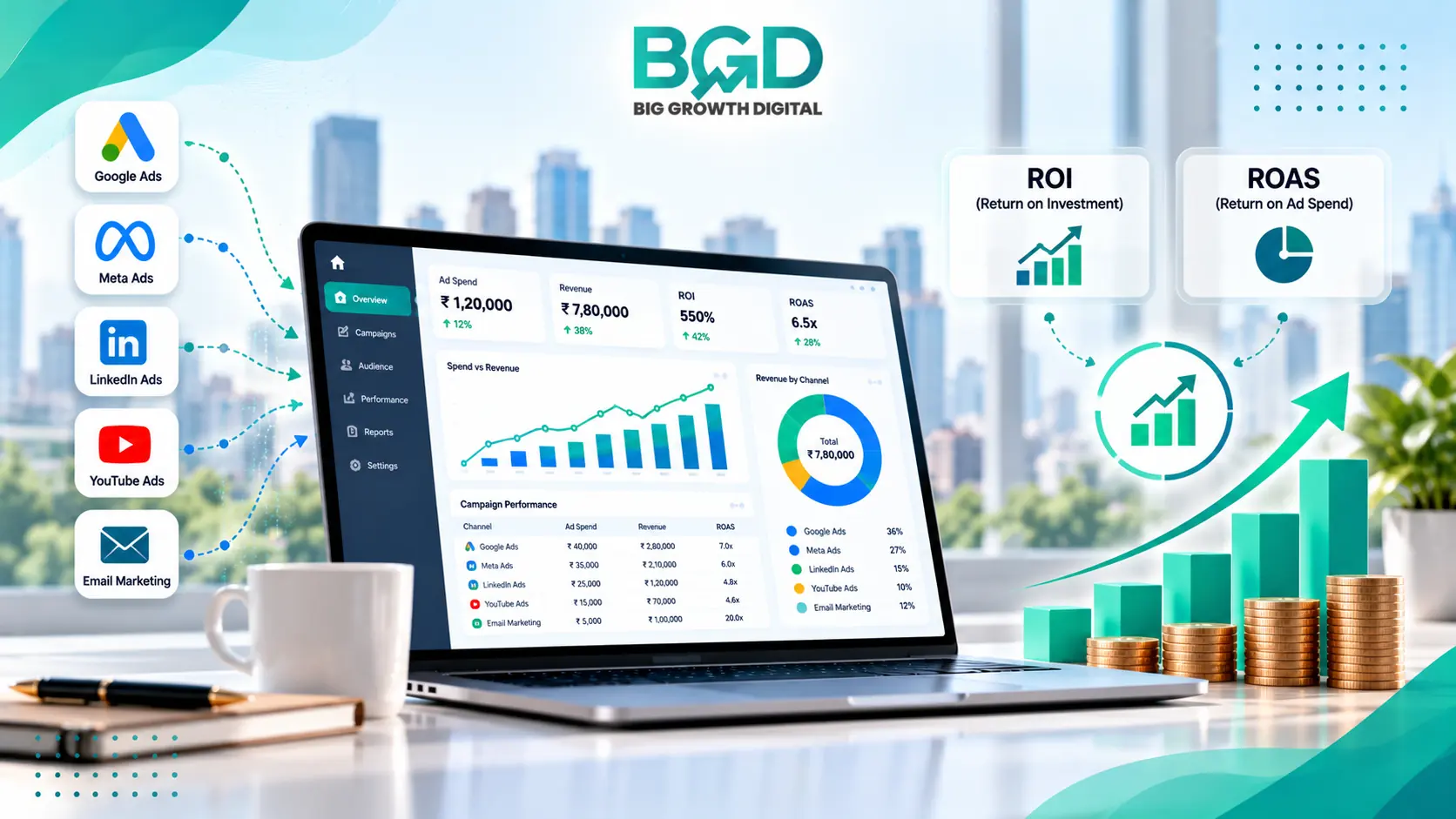
Return on Ad Spend (ROAS) measures the revenue generated for every dollar spent on paid advertising. It helps evaluate the efficiency of channels such as Google Ads, Meta Ads, LinkedIn Ads, and other sponsored campaigns. Although useful for daily optimization, it typically focuses on attributed revenue relative to direct advertising costs rather than the campaign's total expenses.
ROI of Marketing
Marketing Return on Investment (ROI) evaluates the return generated relative to the total investment in marketing. Depending on the calculation method, this can include advertising spend, software subscriptions, video production, contractor costs, and team overhead. Measuring marketing ROI helps business leaders understand whether their marketing investments are delivering an adequate financial return.
Essential Formulas for Financial Assessment
A clear formula helps establish a consistent measurement framework and makes it easier to evaluate campaign performance.
Return on Investment Formula
To calculate the overall return on an investment, compare the return remaining after deducting the relevant investment costs with the total investment.
ROI Formula:
ROI (%) = [(Return − Investment Cost) ÷ Investment Cost] × 100
For example, if you invest $5,000 in an advertising campaign and generate $20,000 in attributed revenue, assuming there are no additional costs and using a simplified revenue-based calculation, the return remaining after the investment is $15,000.
ROI = [($20,000 − $5,000) ÷ $5,000] × 100 = 300%.
This produces a 300% revenue-based ROI, meaning the return above the initial investment equals $3 for every dollar invested. This calculation does not account for product costs, fulfilment, or other business expenses, so it should not automatically be interpreted as net business profit.
Unlike ROAS, which measures attributed revenue against advertising spend, ROI compares the return with the investment cost.
Return on Ad Spend Formula
To calculate advertising efficiency, compare the revenue attributed to a campaign with its direct advertising costs.
ROAS Formula:
ROAS = Attributed Campaign Revenue ÷ Direct Ad Spend
If you spend $5,000 on a targeted LinkedIn advertising campaign and generate $20,000 in attributed revenue, your ROAS is:
ROAS = $20,000 ÷ $5,000 = 4:1, or 400%.
This means the campaign generated $4 in attributed revenue for every $1 spent on advertising. It does not mean the campaign earned $4 in profit per dollar spent.
Key Metrics Required for Accurate Measurement
Calculating financial returns accurately depends on the quality of the data used in your calculations. To improve measurement consistency, track these essential metrics:
Customer Acquisition Cost (CAC): The total sales and marketing cost required to acquire a new paying customer.
Customer Lifetime Value (LTV): An estimate of the total value a customer generates throughout their relationship with your brand. Specify whether the calculation uses revenue or contribution profit.
Gross Profit Margin: The percentage of revenue remaining after deducting the cost of goods sold (COGS).
Conversion Rate: The percentage of users or prospects who complete a defined action, such as submitting a lead form or becoming a paying customer.
Evaluating ROAS alongside customer lifetime value helps businesses avoid cutting campaigns that may have higher initial acquisition costs but generate valuable recurring customers over time. Customer lifetime value should also be considered alongside margins, retention, and customer-serving costs.
A Complete Guide for Calculating Campaign Returns
Following a structured methodology helps maintain consistent reporting across channels and marketing activities.
Step 1: Audit All Direct and Indirect Expenses
Start by listing the costs associated with your campaign. Do not restrict your calculations to direct advertising spend alone. Include relevant freelancer fees, creative production, software subscriptions, agency costs, and dedicated staffing expenses when calculating total marketing investment.
Use a consistent cost definition for every campaign you compare. If certain costs cannot be allocated reliably to individual campaigns, document how they are treated in your reporting.
Step 2: Connect Campaign Income With Closed-Loop Attribution
Connect your website analytics and advertising platforms with your sales CRM to track leads through to closed sales. Closed-loop tracking helps connect campaign interactions with downstream sales outcomes, including cases where a prospect becomes a paying customer several weeks after the initial interaction.
Attribution accuracy depends on consistent tracking, reliable CRM records, appropriate attribution settings, and applicable consent and privacy requirements. Not every conversion can be assigned perfectly to a single touchpoint.
Step 3: Use the Right Formulas
Evaluate both advertising efficiency and the broader financial return of your marketing activities.
Use ROAS to assess attributed revenue relative to direct advertising spend. Use marketing ROI to evaluate the return relative to a clearly defined investment cost.
For more meaningful comparisons, use consistent reporting periods, attribution rules, and cost definitions across campaigns. Where possible, distinguish attributed revenue from incremental revenue that would not have occurred without the marketing activity.
Step 4: Account for Sales Cycle Complexity and Revenue Delays
Sales cycles for B2B enterprise campaigns and high-value consumer products can be lengthy. Assessing profitability too early may underestimate a campaign's eventual contribution, while treating pipeline value as realized revenue can overstate performance.
Track qualified pipeline separately from closed-won revenue. Use consistent reporting windows and revisit campaign performance as opportunities progress through the sales cycle.
Overcoming Common Attribution and Measurement Challenges
Evaluating campaign profitability is rarely straightforward. Modern privacy controls and complex customer journeys present data challenges that marketing teams must address.
Multi-Touch Customer Journeys
Buyers rarely purchase after interacting with just one marketing channel. They may engage with organic content, receive email nurture campaigns, and view social advertisements before converting.
Linear and position-based attribution models distribute conversion credit across touchpoints according to predefined rules. These models can help teams compare marketing interactions, but they do not guarantee that every touchpoint receives credit proportional to its actual contribution to revenue.
Privacy Controls and Tracking Data Loss
Privacy controls, browser restrictions, consent choices, and platform measurement limitations can create gaps in campaign reporting.
First-party data collection and supported server-side tracking or conversion APIs can improve measurement reliability. However, they do not recover every missing conversion or eliminate privacy obligations. Tracking should comply with applicable laws, user consent, and platform policies.
Siloed Channel Analytics
Reviewing advertising platform data in isolation can lead to inconsistent reporting and double-counted conversions. Different platforms may claim credit for the same sale because they use different attribution methods and reporting windows.
Unifying advertising, analytics, CRM, and finance data within a central reporting environment helps establish a more consistent view of marketing performance. Reconcile reported revenue against actual sales records wherever possible.
Maximize Your Marketing Returns With BigGrowth Digital
Consistently calculating, optimizing, and scaling marketing ROI requires reliable tracking, structured reporting, and informed analytical decisions. Without alignment between media budgets and sales CRM outcomes, businesses may struggle to identify which campaigns are contributing to growth.
At Big Growth Digital, we help businesses connect campaign performance with lead quality, CRM outcomes, and revenue reporting. Our services can include campaign tracking, attribution setup, performance dashboards, and paid media optimization, helping marketing teams make more informed decisions about budget allocation and growth opportunities.
Ready to gain greater clarity over your advertising spend and scale revenue with confidence? Partner with Big Growth Digital to build a more measurable and effective marketing strategy.
Frequently Asked Questions (FAQs)
1. What Is Considered a Good Marketing ROI for Digital Campaigns?
There is no universal marketing ROI benchmark that applies to every business. The appropriate return depends on gross margins, acquisition costs, customer lifetime value, cash-flow requirements, and the time needed to recover the investment. A revenue-to-marketing-spend ratio should not be confused with ROI, which measures net return relative to investment. Businesses should define their costs and profitability targets before evaluating campaign performance.
2. How Does the ROAS Formula Differ From Conversion Rate Metrics?
Conversion rate measures the percentage of users who complete a specific action, such as submitting a form or making a purchase. ROAS evaluates attributed revenue relative to advertising spend, providing a financial efficiency metric rather than a conversion-volume percentage.
3. Should Agency Fees and Internal Salaries Be Included in Marketing ROI Calculations?
Yes, when calculating fully loaded marketing ROI, relevant costs such as agency retainers, internal staff salaries, software subscriptions, and production expenses should be included. Define the cost scope consistently so that comparisons between campaigns remain meaningful.
4. How Often Should a Business Review Its Marketing Performance Metrics?
Tactical metrics such as ROAS can be monitored daily or weekly by media buyers to evaluate bids, budgets, and creative performance. Broader financial returns should generally be reviewed monthly or quarterly, depending on sales cycle length, data availability, and business requirements.
5. Why Can a Campaign Show High ROAS but Low Overall ROI?
A campaign can generate high ROAS when attributed revenue is strong relative to direct advertising spend. However, creative production, software, agency fees, labour, product costs, and other expenses may reduce overall profitability. This is why businesses should evaluate ROAS alongside a clearly defined ROI calculation.