




When developers plan a real estate marketing budget, the first question is almost always "how do we generate more leads?" It's the wrong question. More leads without a system to convert them just creates more noise, more calls that go nowhere, more CRM entries that never book a unit.
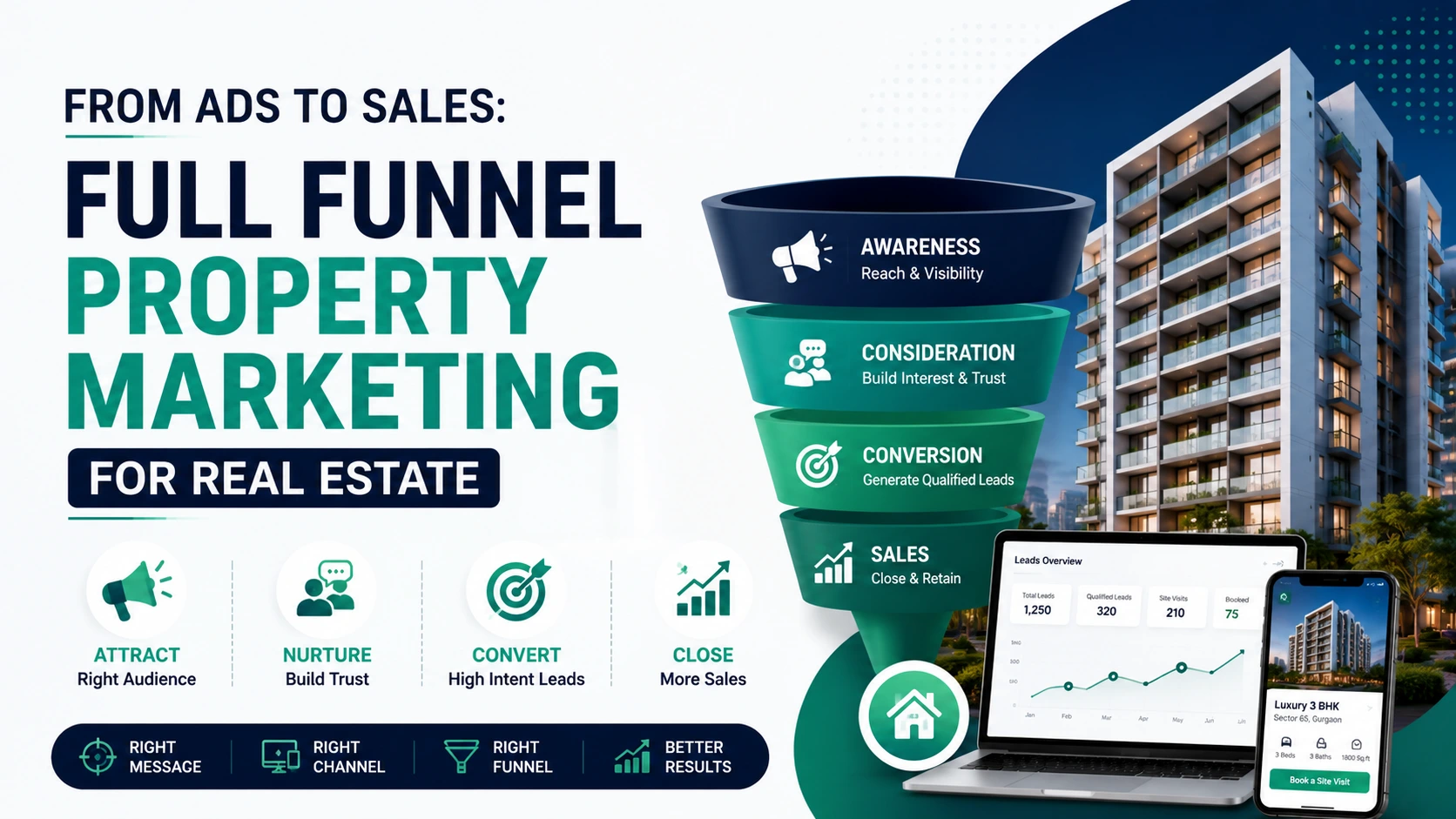
The developers and agents actually closing deals in 2026 aren't winning by outspending competitors on ads. They're winning by controlling the entire journey from the first time someone sees a post about their project to the moment they sign the booking form. That end-to-end journey is what full funnel property marketing means. And right now, most Indian real estate companies are only running the first half of it.
According to ANAROCK Research, the average homebuyer looking at properties in the ₹80 lakh–₹2 crore range takes close to <cite index="15-1">4.5 months to book a home, and during that window views 6 to 8 different projects before deciding.</cite> One ad isn't going to win that buyer. A real estate sales funnel is what wins that buyer.
This post breaks down each stage of the property marketing funnel, what it means for the buyer's experience, and how to actually execute it, not just plan it.
Why Most Real Estate Marketing Only Runs Half the Funnel
The standard playbook looks the same across most developers: run Google Ads, run a Meta campaign, list on a portal like MagicBricks, and let the sales team wait for the phone to ring.
That's top-of-funnel marketing doing a bottom-of-funnel job and it only reaches one type of buyer: the 5-8% who are actively searching right now. The other 90%+ haven't started searching on Google at all. They're watching neighborhood videos, reading about home loan eligibility, or scrolling Instagram without any conscious intent to buy yet but they will, in a few months.
Every buyer in the market falls into one of three groups:
People who don't know your project exists yet
People who've shown interest but haven't decided
People actively comparing options before they commit
A property marketing funnel isn't a single campaign, it's a system that moves buyers from one group to the next, building trust and intent along the way. Treating it as one ad set with one goal is why most real estate marketing plateaus.
Stage 1: Awareness Reaching Cold Audiences
The job of the top of the funnel is simple: put your project in front of buyers before they start actively searching for it. This is where real estate Facebook ads do the heaviest lifting.
Meta's targeting lets developers build audiences by income, age, job title, location, and behavior, not just keywords. A luxury project in Gurgaon, for instance, can target working professionals aged 30-50 in a specific income bracket who've recently engaged with home loan content. These buyers haven't opened Google yet. They don't know they're "in the market." But they're exactly who awareness-stage advertising is built for.
Stage 2: Consideration Warming Up Interested Buyers
Once a buyer starts actively weighing options, the goal shifts from visibility to trust. This is the middle of the real estate customer journey, and it's where most funnels break down because developers keep pushing the same "book now" message that worked at the top.
What actually moves buyers forward at this stage:
Lead with benefits, not specs. Don't just list square footage and amenities and answer "what does this actually change for my life?"
Show social proof. Testimonials, resident interviews, and case studies reduce the anxiety that comes with a multi-lakh decision.
Lower the commitment required to engage. A free site visit, a downloadable payment plan, or a short consultation call all feel safer than "buy now."
Run a nurture sequence. A short series of emails or WhatsApp messages that educate the buyer about the project and your USP without pushing every message toward a hard close.
Act as an advisor, not a salesperson. Asking buyers what actually matters to them (schools nearby, commute time, investment potential) builds the trust that gets them to Stage 3.
Stage 3: Conversion Capturing the Decision Moment
This is where a well-built conversion funnel for builders earns its budget. Three tactics consistently perform here:
Offer-based advertising. Limited inventory alerts, pre-launch pricing, or down payment assistance create urgency for buyers who've been "sitting on the fence." A buyer who's been undecided for 90 days often moves the moment they see "Only 4 units available."
Deeper social proof. Construction-progress videos, RERA compliance confirmation, and resident testimonials give skeptical Indian buyers the reassurance generic ad copy can't.
High-intent search capture. A buyer typing "possession-ready flats in Sector 65 Gurgaon" into Google is at the bottom of the funnel already. This is where Google Ads for real estate paired with a landing page built specifically for that search intent converts better than any other channel in the funnel.
Stage 4: Post-Enquiry The Funnel Nobody Talks About
Most real estate marketing stops measuring success at "lead generated." That's the mistake. What happens after the enquiry decides whether that lead becomes a booking and it's the core of any real lead to sale strategy.
Speed. The first call should happen within 5 minutes of a form submission, not 5 hours. Response time alone is often the difference between winning and losing a buyer to a competitor.
Automated nurturing. If the first call doesn't connect, a structured follow-up sequence should take over brochure within the hour, a virtual tour later that day, an EMI breakdown the next day, a resident testimonial video a few days after. Buyers who aren't ready to talk still need reasons to stay engaged.
Offline conversion tracking. Connecting your CRM to Google Ads so actual bookings not just form fills feed back into the ad platform trains the algorithm to find people who buy, not just people who click.
Key Takeaways
Full funnel property marketing runs across four stages: Awareness, Consideration, Conversion, and Post-Enquiry and each needs a different message and channel.
Roughly 90%+ of buyers aren't actively searching yet; top-of-funnel Meta and video ads reach them before your competitors do.
Retargeting across Meta and Google Display keeps your project visible through the 4-5 month decision window buyers typically take.
Bottom-of-funnel search ads convert the highest-intent buyers searches like "possession ready flats in Sector 65 Gurgaon" to the fastest.
What happens after the inquiry speed of first contact and structured nurturing often decides more deals than the ad spend that generated the lead in the first place.
Real estate marketing that stops at lead generation is only doing half the job. The developers pulling ahead in 2026 are the ones treating the entire buyer journey awareness through to booking as one connected system.