




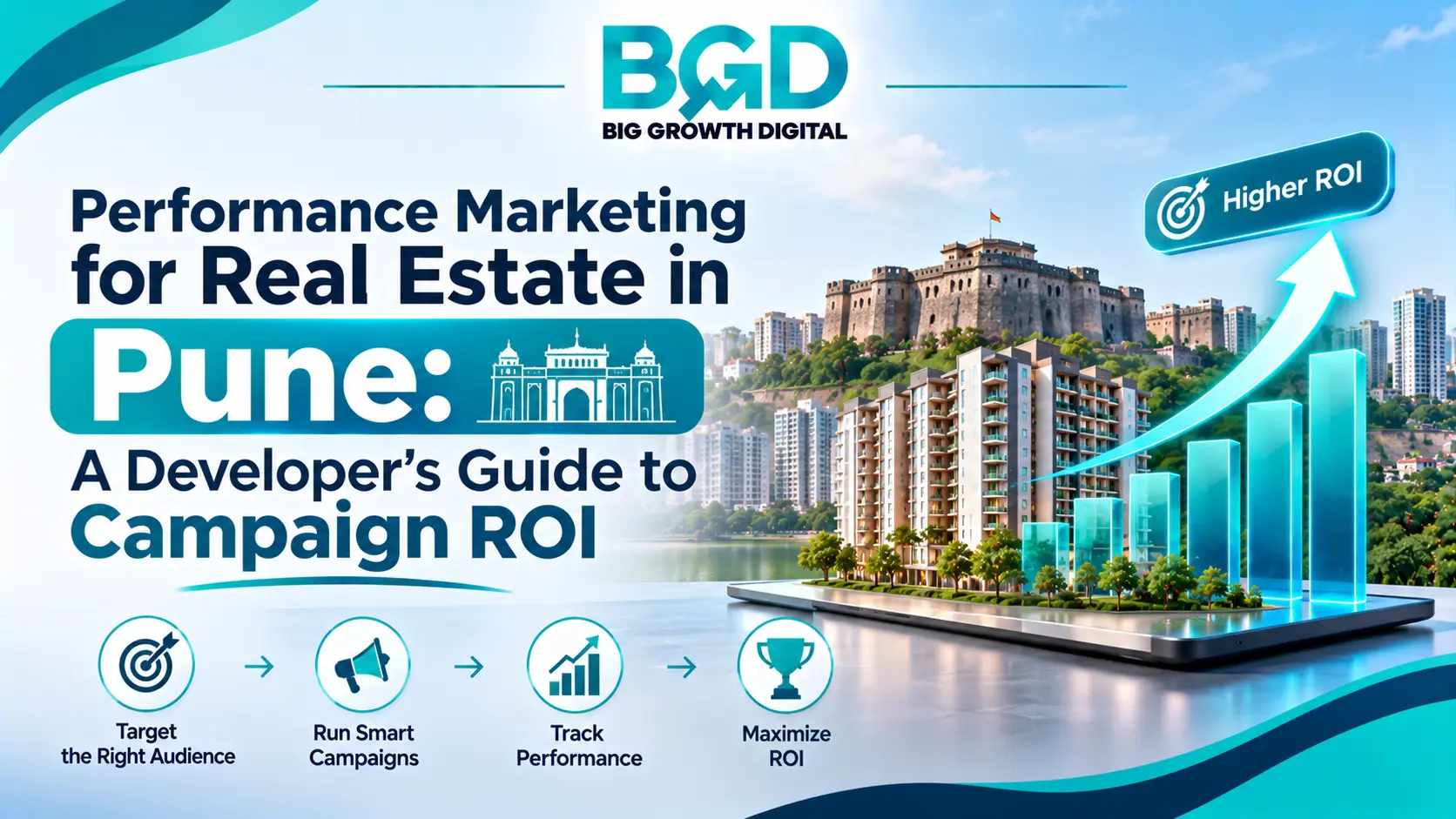
For a real estate developer, a successful marketing campaign is not simply one that generates hundreds of enquiries. The real question is how many of those enquiries turn into qualified prospects, scheduled site visits and actual bookings.
This distinction matters in Pune, where buyers evaluate projects across different locations, budgets and property categories. Someone searching for a home in Baner may have different expectations from a buyer exploring Wagholi, Kharadi, Hinjewadi or Undri. A campaign that ignores these differences can spend heavily without creating enough meaningful sales opportunities.
A well-planned performance marketing strategy for real estate connects advertising expenditure with measurable sales outcomes. By working with a performance marketing agency in Pune, developers can build campaigns that focus on buyer intent, conversion quality and return on marketing investment.
1. Understand where your campaign budget should go
Pune should not be treated as one uniform advertising market. Each micro-market has its own property positioning, buyer profile and competitive environment.
For example:
West Pune: Baner, Wakad and Hinjewadi can be relevant for projects targeting professionals and families seeking access to employment hubs.
East Pune: Kharadi, Viman Nagar and Wagholi may suit campaigns focused on eastern employment corridors and residential demand.
North Pune: Locations such as Moshi, Chikhali and Chakan may require messaging built around connectivity, affordability and project-specific advantages.
South Pune: Undri, Kondhwa and nearby areas may need distinct positioning based on the project's price segment and intended audience.
Market reports also show that demand and new launches are distributed differently across Pune's zones. JLL's Q2 2026 report identified North-East and North Pune as leading sales submarkets, while ANAROCK's Q1 2026 report highlighted activity across West and East Pune. This is a useful reminder to validate campaign assumptions against the specific project and its catchment—not rely on citywide targeting.
Before allocating budget, identify the project's location advantage, price range, configurations, competition and likely buyer segments.
2. Build a campaign around the buyer's decision stage
Not every potential buyer is ready to speak with a sales representative. Campaigns should reflect different levels of purchase intent.
Discovery stage: Introduce the project to relevant audiences through social media, video campaigns and location-based creatives. Communicate the project's key differentiators rather than relying on generic property advertisements.
Research stage: Reach people comparing locations, configurations, amenities and budgets. Search campaigns, remarketing and detailed project content can help address their questions.
Enquiry stage: Target people showing stronger purchase intent with project-specific search ads, clear offers and conversion-focused landing pages.
Consideration stage: Support interested prospects with floor plans, brochures, project updates, location information and opportunities to schedule a site visit.
This structure helps developers avoid treating every click as an immediate sales opportunity. It also gives marketing and sales teams a clearer understanding of what communication a prospect needs next.
3. Use Google Ads to capture active property demand
Search advertising can be valuable when potential buyers are actively looking for a particular property or location.
A campaign for a residential project could target relevant searches such as:
2 BHK flats in Wakad
3 BHK apartments in Baner
New residential projects in Kharadi
Flats near Hinjewadi IT Park
The actual keyword list should be built using search-volume research, competition analysis, project relevance and the developer's budget.
A specialised real estate Google Ads Pune strategy should separate campaigns by location, configuration, project and search intent. This makes it easier to understand which searches generate relevant enquiries.
Important optimisation practices include:
Grouping closely related keywords into focused ad groups.
Using negative keywords to filter irrelevant searches.
Writing ad copy that reflects actual project details.
Sending each campaign to a relevant landing page.
Tracking calls, forms and qualified enquiries.
Reviewing search-term reports and adjusting bids.
Avoid judging search campaigns only by click-through rate. A keyword that attracts fewer clicks may still be valuable if it generates more qualified prospects.
For additional guidance, explore our Google Ads for lead generation guide and Google Ads vs Meta Ads.
4. Make landing pages responsible for conversion
Paid advertising can bring visitors to a website, but the landing page must give them a convincing reason to enquire.
A project-specific landing page should answer the questions buyers are likely to ask before sharing their details:
Where is the project located?
What configurations are available?
What are the key amenities and specifications?
What connectivity or nearby infrastructure is relevant?
How can the visitor request pricing or arrange a site visit?
Keep the enquiry form simple, but collect useful qualification details where appropriate, such as budget range, preferred configuration and purchase timeline.
Also check mobile usability, page speed, form functionality and call-to-action visibility. A complicated form or slow mobile page can waste the traffic generated by an otherwise effective campaign.
Our guide to full-funnel property marketing explains how advertising, landing pages and follow-up activity work together.
Also Read: Real Estate Lead Generation in India
5. Measure ROI beyond cost per lead
One of the biggest mistakes in property advertising is treating low cost per lead as proof of campaign success.
Consider an illustrative example:
A developer spends ₹3 lakh on advertising and receives 300 enquiries. The average cost per lead is ₹1,000. However, if only 30 prospects qualify and 12 schedule site visits, the campaign needs to be evaluated on those deeper outcomes—not just the original 300 enquiries.
The following metrics provide a more useful picture:
Metric | What it tells the developer |
Cost per lead | Average advertising cost per enquiry |
Contact rate | Share of enquiries reached by sales |
Qualified lead rate | Share matching buyer requirements |
Cost per qualified lead | Spend required for a relevant prospect |
Site-visit rate | How effectively enquiries become visits |
Cost per site visit | Advertising spend per scheduled or completed visit |
Booking conversion rate | Share of opportunities converting into bookings |
To estimate campaign ROI, compare the attributable financial return with the total campaign cost. Include relevant advertising and campaign expenses, and define how bookings and revenue are attributed. For longer property sales cycles, track cohorts over time instead of judging a campaign too early.
6. Connect marketing campaigns with the sales pipeline
A lead becomes valuable when the sales team can respond, understand the buyer's requirements and maintain relevant communication.
Developers should connect campaign sources with a CRM or lead-management system. This makes it possible to identify which advertisements, keywords and audiences are producing meaningful sales opportunities.
A platform such as Big Estate can support real estate teams through campaign management, CRM workflows, AI calling and WhatsApp communication. Connecting campaign and lead activity can help teams manage follow-ups and understand what happens after an enquiry is submitted.
A practical process includes:
Assign new enquiries to the appropriate sales representative.
Record contact attempts and conversation outcomes.
Classify leads by budget, configuration and buying timeline.
Track site visits and subsequent sales discussions.
Share sales feedback with the marketing team.
This feedback loop helps a real estate performance marketing agency in Pune identify whether poor results come from targeting, campaign messaging, landing pages or the follow-up process.
7. Choose a partner that understands campaign economics
A performance marketing agency in Pune should be able to explain how its work contributes to business outcomes—not simply present impressions and clicks.
Before appointing a partner, ask for clarity on:
How it researches project locations and buyer segments.
How it divides budgets between Google, Meta and other channels.
How it measures qualified leads and site visits.
Whether conversion tracking and CRM integration are included.
How often campaign performance is reviewed.
How sales feedback influences optimisation.
Review relevant real estate marketing case studies and ask how campaign objectives, measurement and results were established. You can also explore our real estate lead generation ideas for additional approaches to attracting relevant prospects.
Conclusion: Make campaign ROI the centre of property marketing
Real estate advertising should create a measurable path from the first interaction to a genuine sales opportunity. That requires more than increasing budgets or collecting enquiries. Developers need accurate audience targeting, relevant advertisements, conversion-focused landing pages, reliable lead tracking and consistent sales follow-up.
The right performance marketing agency in Pune can help bring these activities together through a campaign strategy built around qualified leads, site visits and business outcomes. When marketing and sales teams work with shared data, developers can identify what is working, reduce wasted spend and make more informed investment decisions.
Connect with Big Growth Digital to discuss your real estate campaign objectives, lead generation strategy and performance marketing opportunities.
Also Read: Performance Marketing for Real Estate in Bangalore
Frequently Asked Questions
1. What does a performance marketing agency in Pune do for real estate developers?
A performance marketing agency in Pune plans and manages measurable digital campaigns for property projects. Services may include Google Ads, Meta Ads, audience targeting, landing-page optimisation, conversion tracking and lead-quality reporting.
2. How does performance marketing for real estate improve campaign ROI?
It improves campaign decision-making by tracking the complete journey from advertising clicks to qualified enquiries, site visits and bookings. Developers can use this information to optimise budgets and reduce spending on low-quality sources.
3. What should developers look for in a real estate performance marketing agency in Pune?
Look for real estate industry experience, campaign strategy, transparent reporting, conversion tracking, CRM integration and the ability to measure qualified leads and site visits rather than only enquiry volume.
4. How can developers improve property lead generation Pune campaigns?
Developers can improve property lead generation Pune campaigns through micro-market targeting, relevant property keywords, project-specific landing pages, creative testing and timely sales follow-ups.
5. Is real estate Google Ads Pune suitable for new project launches?
Yes. Search campaigns can help new projects reach people actively researching properties in relevant locations. Their effectiveness depends on keyword intent, competition, project positioning, landing-page quality and lead follow-up.