




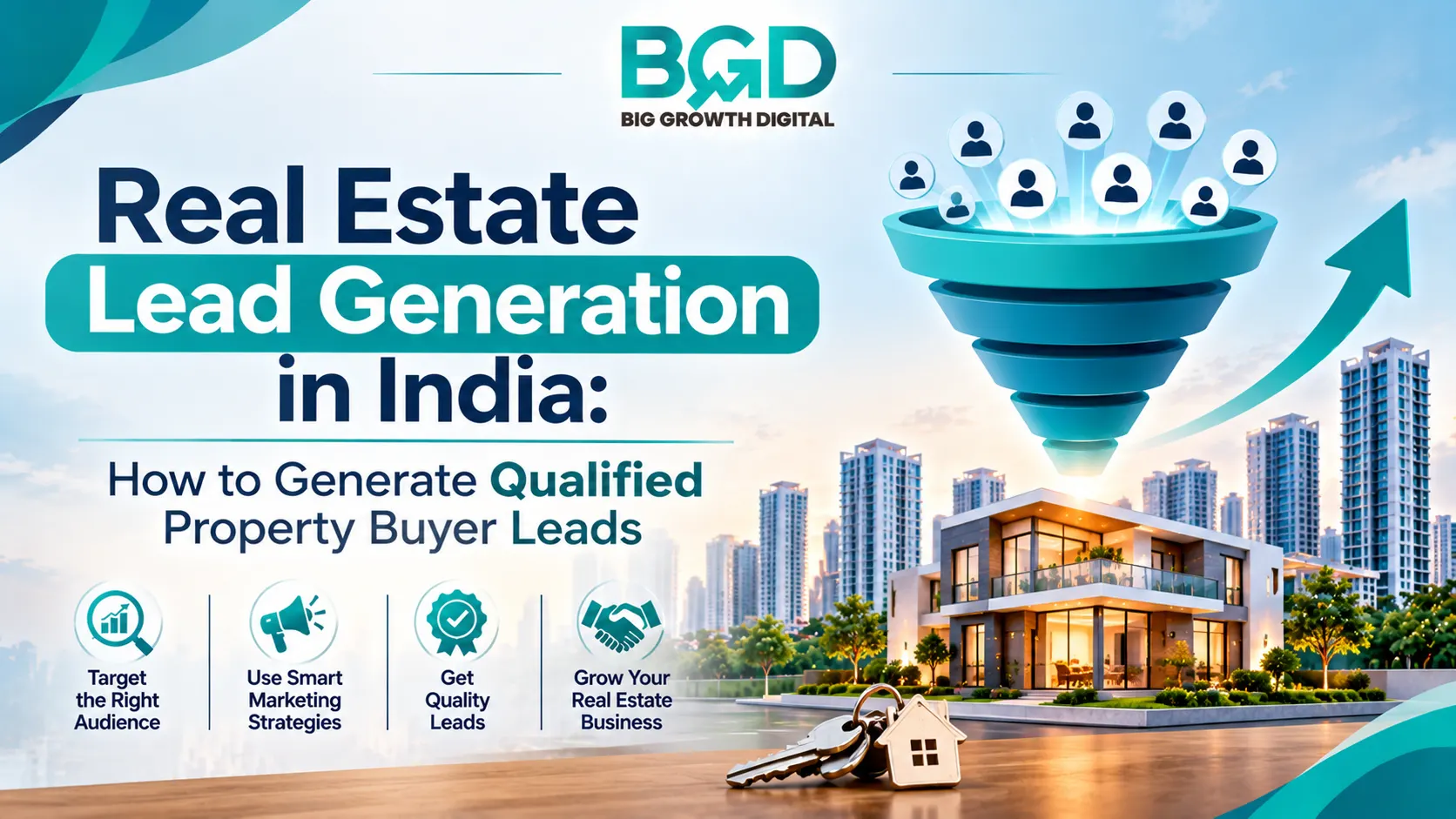
Every real estate project needs buyers. But attracting hundreds of enquiries does not necessarily mean a project is moving closer to its sales target.
A campaign may generate thousands of form submissions, yet the sales team might struggle to connect with prospects, schedule site visits, or identify buyers who are genuinely interested. Some enquiries may come from people outside the project's budget, others may be exploring multiple locations, and many may not be ready to purchase for several months.
This is where real estate lead generation needs to move beyond collecting phone numbers.
For developers, builders, brokers, channel partners, and property marketing teams across India, the objective is to attract the right audience, understand their buying intent, build trust, and guide them towards the next step in their property-buying journey.
Whether you are marketing residential apartments, luxury villas, plotted developments, commercial spaces, or investment properties, a successful property lead generation strategy combines the right channels, compelling communication, accurate targeting, lead qualification, and consistent follow-up.
Let's explore how real estate businesses can build a more effective buyer acquisition system.
1. Why Real Estate Lead Generation Is More Than Collecting Enquiries
Property purchases involve significant financial commitments. Buyers typically research locations, compare projects, evaluate prices, check amenities, discuss financing, and consult family members before making a decision.
This means a real estate lead may enter your pipeline at several different stages.
Someone searching for apartments in a particular locality may already be evaluating projects. Another person watching a property walkthrough may only be exploring possibilities. A prospect who downloads a brochure may be interested but still needs information about pricing, possession, or financing.
Treating all these prospects equally creates inefficiencies.
A better approach is to understand the difference between:
Awareness-stage prospects: People discovering your project or brand for the first time.
Research-stage prospects: Buyers comparing locations, configurations, developers, and prices.
High-intent prospects: People actively enquiring about availability, pricing, payment plans, or site visits.
Sales-ready prospects: Buyers whose requirements, budget, timeline, and interest align with your offering.
Your marketing strategy should attract prospects across these stages while identifying which enquiries need immediate sales attention and which require nurturing.
The objective is not simply to increase lead volume. It is to create a pipeline of potential buyers your sales team can meaningfully engage with.
2. Start With the Buyer, Not the Advertising Platform
One of the most common mistakes in property marketing is choosing advertising platforms before defining the target audience.
A residential project targeting first-time homebuyers requires different messaging from a premium project targeting senior professionals, investors, or high-net-worth individuals.
Similarly, a plotted development may attract buyers interested in long-term investment, land ownership, or future construction, while a commercial property campaign may target business owners, retailers, investors, or corporate occupiers.
Before launching campaigns, define your buyer profile.
Consider:
Preferred location and connectivity.
Property type and configuration.
Approximate purchase budget.
Purpose of purchase: investment or end-use.
Employment or business profile.
Purchase timeline.
Financing requirements.
Key concerns and decision-making factors.
For example, a project targeting working professionals near a major employment hub may emphasise commute convenience, lifestyle amenities, and connectivity.
A luxury project may require stronger visual storytelling, exclusivity, architectural details, location advantages, and personalised engagement.
When the buyer profile is clear, the advertising message, landing page, targeting, and lead qualification process become more relevant.
3. Which Channels Generate Property Buyer Leads in India?
A strong acquisition strategy rarely depends on one platform. Different channels serve different purposes, and their effectiveness depends on project location, pricing, audience, competition, and campaign execution.
Google Search Ads: Capture Existing Buying Intent
Google Search Ads help businesses reach people actively searching for properties, projects, locations, or specific configurations.
Searches such as "3 BHK flats in Gurgaon," "luxury apartments in Hyderabad," or "plots near Bangalore" indicate that users are researching particular property requirements.
Search campaigns can target:
Project-specific keywords.
Location-based property searches.
Property type and configuration keywords.
Price-related searches.
Investment-related property searches.
Developer and brand searches.
The landing page should match the search intent. Someone searching for a specific configuration should not be redirected to a generic homepage without relevant information.
Include property details, location, amenities, pricing information where appropriate, project imagery, enquiry options, and a clear call to action.
Meta Ads: Build Demand and Reach Relevant Audiences
Facebook and Instagram advertising are useful for introducing projects to relevant audiences who may not yet be actively searching.
Campaigns can use:
Project walkthrough videos.
Lifestyle creatives.
Location-focused advertisements.
Construction progress updates.
Lead generation forms.
Click-to-WhatsApp campaigns.
Offers and launch announcements.
Retargeting campaigns.
Meta campaigns can generate enquiry volume, but the quality of enquiries depends heavily on the creative, audience, offer, form experience, and follow-up process.
Avoid evaluating campaigns solely by the number of leads generated. Compare lead quality, contactability, site visits, and conversion progression.
Property Portals: Reach Active Property Searchers
Property portals attract audiences actively exploring listings and projects.
They can be useful for residential resale, rentals, new launches, and project discovery, particularly when listings contain accurate details, quality imagery, pricing information, and responsive enquiry handling.
However, portal enquiries may be shared, duplicated, or simultaneously submitted to multiple properties.
Your sales team should have a process for responding quickly, identifying the buyer's requirement, and recording the enquiry source.
SEO: Build Long-Term Organic Lead Acquisition
Search engine optimisation can help real estate businesses attract prospective buyers without relying entirely on paid advertising.
Useful SEO content includes:
Locality guides.
Project pages.
Property configuration pages.
Location comparison articles.
Infrastructure and connectivity content.
Buying guides.
Investment-related educational content.
Frequently asked questions about property purchases.
For example, a developer can build relevant content around the local area, property configurations, nearby infrastructure, amenities, and project-specific questions.
Businesses looking to expand their organic acquisition strategy can also explore practical real estate lead generation ideas that go beyond paid advertising. Combining SEO, content marketing, location-specific landing pages, social media, and referral strategies can help property businesses attract potential buyers through multiple touchpoints.
SEO requires consistent investment and time, but it can build visibility across different stages of buyer research.
Video and YouTube Marketing
Property videos help buyers visualise a project before visiting the site.
Useful formats include walkthroughs, location tours, amenity demonstrations, construction updates, project explainers, testimonials, and comparison videos.
Video content can also be used for remarketing. Users who watched a project video or engaged with social content may be retargeted with a more specific message encouraging them to request details or schedule a site visit.
These channels work best when they are part of a coordinated marketing strategy rather than isolated activities. Businesses can explore how a real estate digital marketing strategy combines search visibility, paid campaigns, content, creative production, audience targeting, and lead generation to create a more connected buyer acquisition journey.
4. Build Landing Pages That Give Buyers a Reason to Enquire
Generating traffic is only one part of the acquisition process. Your landing page needs to turn that traffic into meaningful enquiries.
A poorly designed page can waste advertising spend even when the campaign targets the right audience.
A project landing page should answer the buyer's important questions without making them search through multiple pages.
Include:
Project name and location.
Property type and configuration.
Key project details.
Amenities and differentiating features.
Location and connectivity information.
Relevant photographs, renders, or videos.
Pricing or indicative price information where suitable.
Enquiry form.
Call and WhatsApp options.
Clear next-step CTA.
Avoid overwhelming visitors with long forms. Capture essential information initially, then gather additional details during the sales conversation.
The CTA should communicate a useful next step rather than simply asking users to submit information.
Examples include:
Request Project Details
Get the Latest Price List
Schedule a Site Visit
Explore Available Units
Speak With a Property Advisor
The objective is to make the enquiry process easy while giving buyers a clear reason to engage.
5. How to Qualify Real Estate Buyer Leads
Not every enquiry is equally valuable. Your sales team needs a consistent method to understand which prospects are likely to progress.
A practical qualification framework includes four important factors.
Budget
Does the prospect's expected investment align with the project's pricing?
Understanding the budget early can prevent unnecessary conversations about properties that are financially unsuitable.
Requirement
What does the buyer actually need?
Property type, configuration, location, size, amenities, and purpose of purchase can help determine whether the project is a suitable match.
Timeline
Is the prospect planning to purchase immediately, within a few months, later in the year, or simply exploring?
Timeline helps determine the urgency and follow-up frequency.
Buying readiness
Has the prospect explored financing, discussed the decision with family, shortlisted projects, or expressed interest in visiting the property?
These signals help sales teams prioritise conversations.
A simple lead classification system can be useful:
Lead category | Characteristics | Recommended action |
Hot | Suitable budget, strong interest, near-term purchase | Immediate call and site-visit scheduling |
Warm | Relevant requirement, actively researching | Personalised follow-up and project information |
Nurture | Early-stage interest or longer timeline | Educational content and periodic follow-up |
Unqualified | Requirement or budget does not match | Record accurately and avoid excessive sales effort |
Lead qualification should not become an interrogation. The objective is to understand the prospect's needs and recommend the most relevant next step.
6. Improve Lead Quality Through Better Advertising and Messaging
If campaigns consistently generate irrelevant enquiries, the solution may not be increasing the advertising budget.
Review your campaign communication.
Does the advertisement clearly explain the property type? Is the location visible? Is the price range or positioning appropriate for the audience? Does the creative attract people who genuinely match the project?
For example, a campaign advertising a premium property without communicating its positioning may attract users expecting substantially lower prices.
Similarly, an advertisement highlighting an investment opportunity without explaining the actual offering may generate curiosity rather than purchase intent.
Use messaging that pre-qualifies the audience naturally.
Test different creative angles:
Location and connectivity.
Lifestyle and amenities.
Property configuration.
Price and payment options.
Investment positioning.
Project differentiators.
Developer credibility.
Measure which messages generate the most relevant enquiries—not simply the highest engagement.
7. Follow-Up Is Where Many Leads Are Lost
A buyer enquiry is an opportunity, not a completed sale.
If a prospect submits a form and receives no response for several hours, they may already have contacted competing projects.
Real estate businesses should establish a clear lead-response process.
A practical follow-up sequence may look like this:
Immediately after enquiry: Send an acknowledgement and assign the enquiry to the responsible sales representative.
First contact: Call the prospect, understand their requirement, answer initial questions, and establish their interest level.
If unreachable: Send a relevant WhatsApp message confirming the enquiry and offering project information.
After initial conversation: Share the brochure, price details, floor plans, walkthrough video, or other requested information.
Follow-up: Schedule the next interaction based on the prospect's buying timeline and interest.
Site visit: Confirm the appointment, provide location details, and coordinate with the sales team.
After the visit: Record feedback, understand objections, and identify the next action.
The follow-up should be personalised. Repeated generic messages such as "Are you interested?" rarely provide meaningful value.
Instead, share information that addresses the buyer's questions or helps them make a decision.
8. Use Big Estate to Connect Marketing Enquiries With Sales Follow-Ups
When enquiries arrive through multiple channels, managing them manually becomes increasingly difficult.
Leads may be scattered across advertising platforms, website forms, spreadsheets, call records, and WhatsApp conversations. Sales teams may lose track of follow-ups, duplicate enquiries, or fail to identify which campaigns are generating better opportunities.
This is where lead management and marketing coordination become important.
Big Estate helps real estate businesses organise lead management and marketing workflows through capabilities including:
Campaign management.
Lead tracking and management.
AI calling.
WhatsApp communication.
Follow-up coordination.
Marketing and sales visibility.
For real estate developers and sales teams, a more organised system can help connect enquiry generation with the follow-up process.
Instead of evaluating marketing only by the number of forms submitted, businesses can build better visibility into lead status, sales activity, and campaign performance.
Explore Big Estate to understand how technology can support the real estate lead management process.
9. Measure What Happens After the Lead Is Generated
A campaign should not be judged only by impressions, clicks, or total enquiries.
Track the complete journey wherever your measurement setup supports it.
Metric | What it tells you |
Cost per lead (CPL) | Cost of generating an enquiry |
Contact rate | Percentage of leads successfully contacted |
Qualified lead rate | Percentage matching the project's target buyer |
Site-visit rate | Percentage progressing to property visits |
Visit attendance rate | Percentage of scheduled visits completed |
Booking rate | Percentage progressing to bookings |
Cost per site visit | Marketing cost associated with generating visits |
Cost per booking | Marketing cost associated with completed bookings |
For example, Campaign A may produce a higher number of enquiries at a lower cost, while Campaign B generates fewer enquiries but more qualified prospects and site visits.
If Campaign B produces stronger business outcomes, it may deserve more investment despite its higher initial cost per lead.
Marketing teams and sales teams should regularly review these metrics together.
This helps identify whether the problem lies in targeting, advertising, lead qualification, response time, sales communication, or the project offering itself.
10. What Successful Real Estate Lead Generation Campaigns Need
A successful campaign is rarely the result of a single advertisement.
It requires a connected strategy involving:
A clearly defined buyer profile.
A compelling project proposition.
Appropriate marketing channels.
Strong creative execution.
Relevant landing pages.
A structured lead qualification process.
Fast and consistent follow-up.
Lead management technology.
Performance reporting.
Continuous campaign optimisation.
You can explore Big Growth Digital's real estate case studies to see examples of real estate campaign objectives and marketing approaches across different projects.
The portfolio includes campaigns focused on qualified property lead generation, investor-focused pipelines, brand awareness, and driving customer walk-ins—objectives that require different approaches rather than one standard advertising formula.
The important lesson is that property lead generation should be built around the project's commercial objective and buyer journey.
Conclusion
Effective real estate lead generation in India is about attracting the right prospects, understanding their requirements, and helping them progress from initial interest to meaningful sales conversations.
Google Ads, Meta campaigns, property portals, SEO, video marketing, and referrals can all contribute to buyer acquisition. But channel selection alone will not determine success.
The quality of your messaging, lead qualification, response process, follow-up, sales coordination, and performance measurement ultimately influence how much value your marketing investment creates.
For developers, brokers, and property businesses, the goal should be to build a predictable and measurable lead acquisition system—not simply generate more enquiries every month.
Connect with Big Growth Digital to build a real estate marketing and lead generation strategy aligned with your project, target audience, and sales goals.
Frequently Asked Questions
1. What is real estate lead generation?
Real estate lead generation is the process of attracting and capturing potential property buyers, investors, tenants, or sellers and collecting their enquiry details so a real estate business can engage with them.
2. How can real estate businesses generate qualified buyer leads in India?
Businesses can combine Google Search Ads, Meta advertising, SEO, property portals, project landing pages, video marketing, referrals, channel partners, and follow-up campaigns. Qualification based on budget, requirement, timeline, and buying readiness helps identify suitable prospects.
3. What is the difference between property lead generation and lead conversion?
Property lead generation attracts potential customers and captures their enquiry information. Lead conversion involves engaging those prospects, understanding their requirements, building trust, scheduling site visits, and progressing them towards a booking or transaction.
4. How can agents get leads for real estate agents without relying only on paid advertising?
Agents can build organic visibility through SEO, locality-specific content, Google Business Profile, referrals, property videos, social media, networking, channel partnerships, and consistent engagement with their existing audience.
5. How do you improve real estate buyer leads?
Improve targeting, communicate pricing and property details clearly, use relevant creatives, optimise enquiry forms, qualify prospects, respond quickly, and track lead quality and site visits instead of focusing only on total enquiry volume.
6. Why is follow-up important in real estate lead generation?
Property buyers often compare multiple projects and take time to decide. Timely, relevant follow-up helps answer questions, maintain engagement, build trust, and encourage prospects to progress towards a site visit or purchase.