




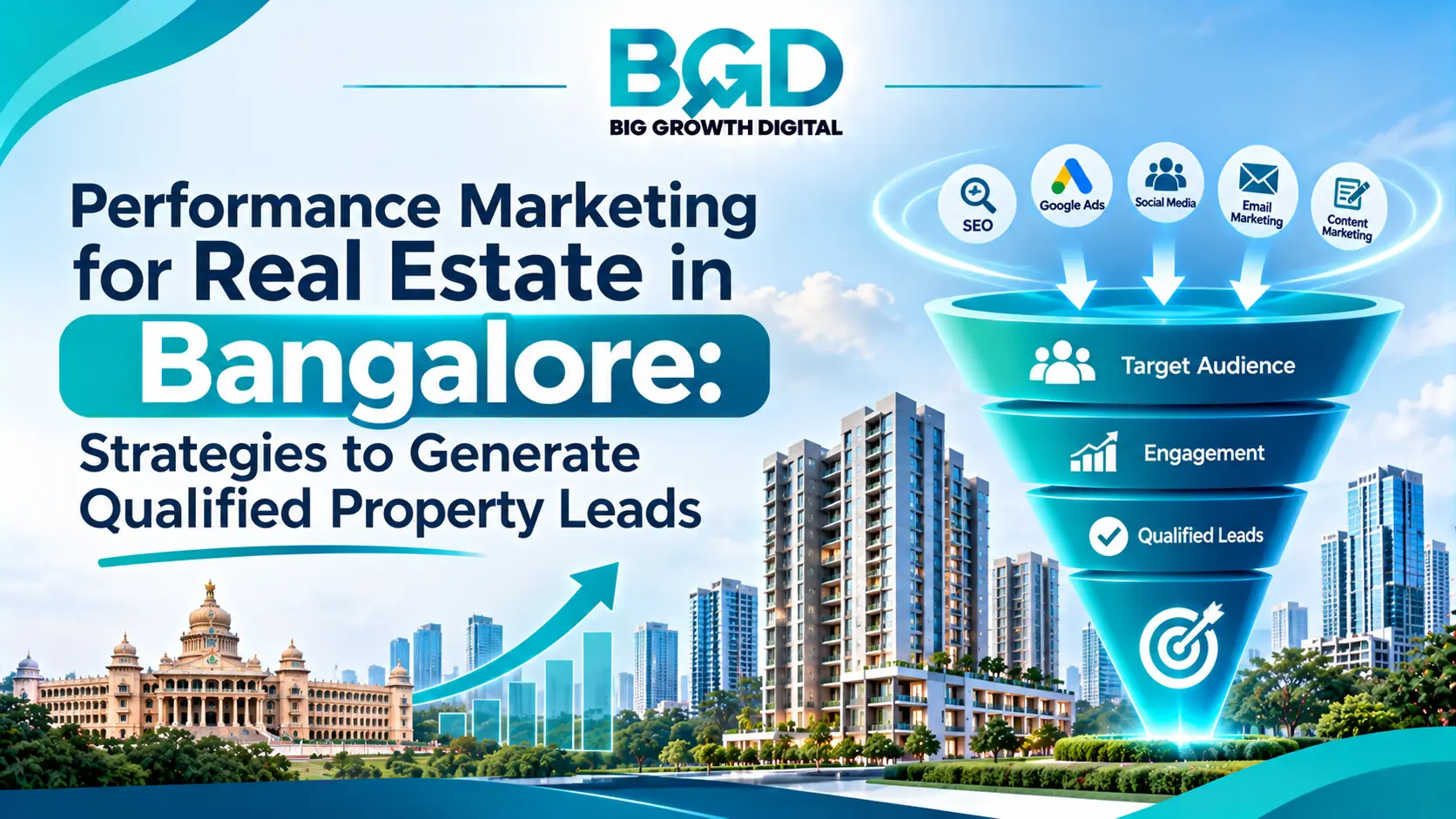
Bengaluru's property market is not one audience with one buying preference. A buyer exploring an apartment near Whitefield may have different priorities, budgets and timelines from someone considering a villa around Sarjapur Road or a home in North Bengaluru. Running the same advertisement across these audiences can generate enquiries, but it does not necessarily generate serious prospects.
This is where performance marketing for real estate needs a more considered approach. Developers must connect audience targeting, campaign messaging, landing-page experience and sales follow-up to attract people who are genuinely interested in a project.
Working with a performance marketing agency in Bangalore can help developers build campaigns around measurable business outcomes—not simply clicks, impressions or enquiry volume.
1. Start with the project’s buyer profile, not the advertising platform
Before choosing Google, Meta or another advertising channel, define who is most likely to buy the property.
A residential project in Whitefield might appeal to technology professionals working around the eastern IT corridor. A premium development near Sarjapur Road may attract families looking for larger homes, connectivity and lifestyle amenities. A plotted development on the outskirts could appeal to a different combination of investors and end users.
Build a buyer profile using:
Location: Where does the potential buyer currently live or work?
Budget: What property price range is realistic for the audience?
Property preference: Apartment, villa, plotted development or luxury residence?
Purchase timeline: Is the person actively searching or researching for a future purchase?
Buying motivation: End use, investment, relocation or family requirements?
Recent Bengaluru market reports highlight activity across several residential corridors, including Varthur, Panathur Road and Sarjapur Road. This reinforces why campaigns should reflect the project's actual catchment rather than rely on broad city-level targeting.
2. Match the advertising channel to buyer intent
A common campaign mistake is expecting every platform to produce the same type of lead. Different channels serve different stages of the property-buying journey.
Google Search Ads: Capture active demand
Search campaigns can reach people already looking for properties using specific queries. For example, a developer could target searches related to apartments in Whitefield, luxury flats near Sarjapur Road or 3 BHK homes in a defined budget range.
Organise campaigns by project, location, property type and search intent. Use negative keywords to reduce irrelevant clicks, and send each advertisement to a relevant project landing page.
Meta Ads: Build awareness and consideration
Facebook and Instagram can introduce a project to relevant audiences through walkthrough videos, amenity creatives, location-focused campaigns and lead-generation formats.
Instead of using one generic advertisement, test different messages: connectivity, floor plans, lifestyle facilities, construction updates or project specifications. Retarget users who have engaged with the brand or visited relevant pages, where platform policies and consent requirements permit.
YouTube and video campaigns: Explain the project
Video can communicate a project's layout, surroundings and experience more effectively than a short text advertisement. Use walkthroughs, location explainers and project updates to answer questions that potential buyers may have before enquiring.
The right channel mix depends on the project, budget, audience and campaign objective. A good real estate performance marketing plan does not allocate money equally across platforms; it invests where meaningful buyer actions are happening.
3. Build landing pages that qualify interest
An advertisement can attract attention, but the landing page influences whether that attention becomes a useful enquiry.
Avoid sending every campaign to the homepage. Create dedicated landing pages that continue the same message used in the advertisement.
A project landing page should clearly communicate:
Project location and nearby connectivity
Property configurations and available options
Indicative pricing or a clear way to request pricing
Amenities, specifications and relevant project details
Construction or possession information, where applicable
A visible enquiry or site-visit option
The enquiry form should collect enough information for the sales team to understand the prospect without making submission unnecessarily difficult. Depending on the project, useful fields may include preferred configuration, budget range, purchase timeline and contact details.
For a deeper look at how campaigns and conversion journeys work together, read our guide to full-funnel property marketing.
4. Optimise for qualified leads, not the cheapest enquiry
A campaign generating leads at a lower cost is not automatically the better campaign. If most enquiries are unreachable, outside the project's budget or unrelated to the location, the apparent cost advantage can disappear.
Developers should evaluate lead quality using a consistent qualification process. For example, classify enquiries as:
New enquiry: A person has submitted a form or contacted the sales team.
Contacted lead: The sales team has successfully reached the prospect.
Qualified lead: The prospect matches relevant budget, location and purchase requirements.
Site visit scheduled: The prospect has agreed to visit the project.
Sales opportunity: The prospect is actively considering a purchase.
This classification helps identify where the funnel is losing potential buyers.
For instance, if a campaign generates many enquiries but few site visits, the problem may involve audience quality, response time, pricing expectations or the sales conversation. Increasing the advertising budget without investigating the issue may only increase the number of weak leads.
Explore more practical approaches in our article on real estate lead generation ideas and real estate lead generation in India.
5. Connect advertising with CRM, calling and follow-ups
Property enquiries often need several interactions before a buyer agrees to a site visit. A delayed response or missed follow-up can weaken an otherwise effective campaign.
Developers should connect advertising platforms with a central lead-management process. This helps sales teams track enquiry sources, assign leads, record conversations and monitor follow-up activity.
A platform such as Big Estate can support real estate teams with campaign management, CRM workflows, AI calling and WhatsApp communication. When campaign and sales activity are connected, teams can get a clearer view of what happens after a person submits an enquiry.
Useful practices include:
Assigning new leads to the right sales representative.
Setting follow-up reminders and tracking response times.
Recording call outcomes and buyer requirements.
Using relevant WhatsApp communication for project information and follow-ups.
Tracking site visits and sales outcomes against campaign sources.
Automation should support timely, relevant communication—not send repetitive messages that ignore the buyer's actual interest.
6. Measure the numbers that influence revenue
A reliable campaign report should connect advertising costs with sales activity. Cost per lead is useful, but it is only one part of the picture.
Metric | What it helps measure |
Cost per lead (CPL) | Average cost of generating an enquiry |
Lead-to-contact rate | How many enquiries sales teams reach |
Qualified lead rate | Share of enquiries matching buyer criteria |
Cost per qualified lead | Advertising cost for a relevant prospect |
Site-visit rate | Ability to convert interest into visits |
Cost per site visit | Spend required to generate a visit |
Sales conversion rate | How effectively opportunities become bookings |
Review these metrics by campaign, audience, keyword, creative and project. This makes it easier to move budgets away from weak segments and invest in campaigns producing better sales opportunities.
Our guide to Google Ads for lead generation explains how campaign structure and optimisation can influence lead outcomes.
Also Read: Google Ads vs Meta Ads
7. What should developers expect from a performance marketing partner?
A capable performance marketing agency in Bangalore should understand more than advertising dashboards. It should be able to connect the project's positioning with audience research, campaign execution, landing-page optimisation and sales feedback.
Before selecting a partner, ask how it will:
Research the project's location, competition and buyer segments.
Separate campaigns by property type, budget and intent.
Test creative formats and landing-page messages.
Track qualified leads and site visits, not just form submissions.
Share transparent reports and explain optimisation decisions.
Coordinate with the internal sales team and CRM process.
Review relevant real estate marketing case studies to understand how an agency approaches campaign objectives, execution and measurable outcomes. Look for evidence that is relevant to your project rather than relying only on broad performance claims.
Conclusion: Make every property marketing campaign accountable
Successful real estate advertising is not about generating the maximum number of enquiries at the lowest possible cost. It is about reaching relevant buyers, communicating the project's value, capturing genuine interest and helping the sales team move prospects towards site visits and bookings.
A performance marketing agency in Bangalore should bring these activities together through a measurable campaign strategy. With the right audience segmentation, search and social advertising, conversion-focused landing pages, CRM integration and sales feedback, developers can make better decisions about where their marketing budget goes.
Connect with Big Growth Digital to discuss your real estate marketing objectives, qualified lead generation strategy and campaign growth opportunities.
Frequently Asked Questions
1. What does a performance marketing agency in Bangalore do for real estate developers?
A performance marketing agency in Bangalore plans and manages measurable digital campaigns for property projects. Its work may include Google Ads, Meta Ads, audience targeting, landing-page optimisation, lead tracking and campaign reporting.
2. How does performance marketing for real estate generate qualified leads?
It combines relevant audience targeting, intent-based advertising, project-specific landing pages and lead qualification. CRM tracking and timely sales follow-ups help identify which enquiries are more likely to become site visits or sales opportunities.
3. Which platforms work best for real estate performance marketing?
Google Search Ads can capture active property demand, while Meta Ads can build awareness and generate consideration. YouTube can support project discovery through video. The right mix depends on the project's audience, location, budget and objectives.
4. How can developers improve property lead generation Bangalore campaigns?
Developers can improve property lead generation Bangalore campaigns by targeting specific micro-markets, using relevant property keywords, testing creative messages, improving landing pages and measuring qualified leads and site visits.
5. When should a developer hire a real estate PPC agency in Bangalore?
A developer may consider a real estate PPC agency in Bangalore when launching a project, entering a new market, scaling paid search campaigns or improving lead quality. The agency should provide transparent reporting and connect advertising performance with sales outcomes.