




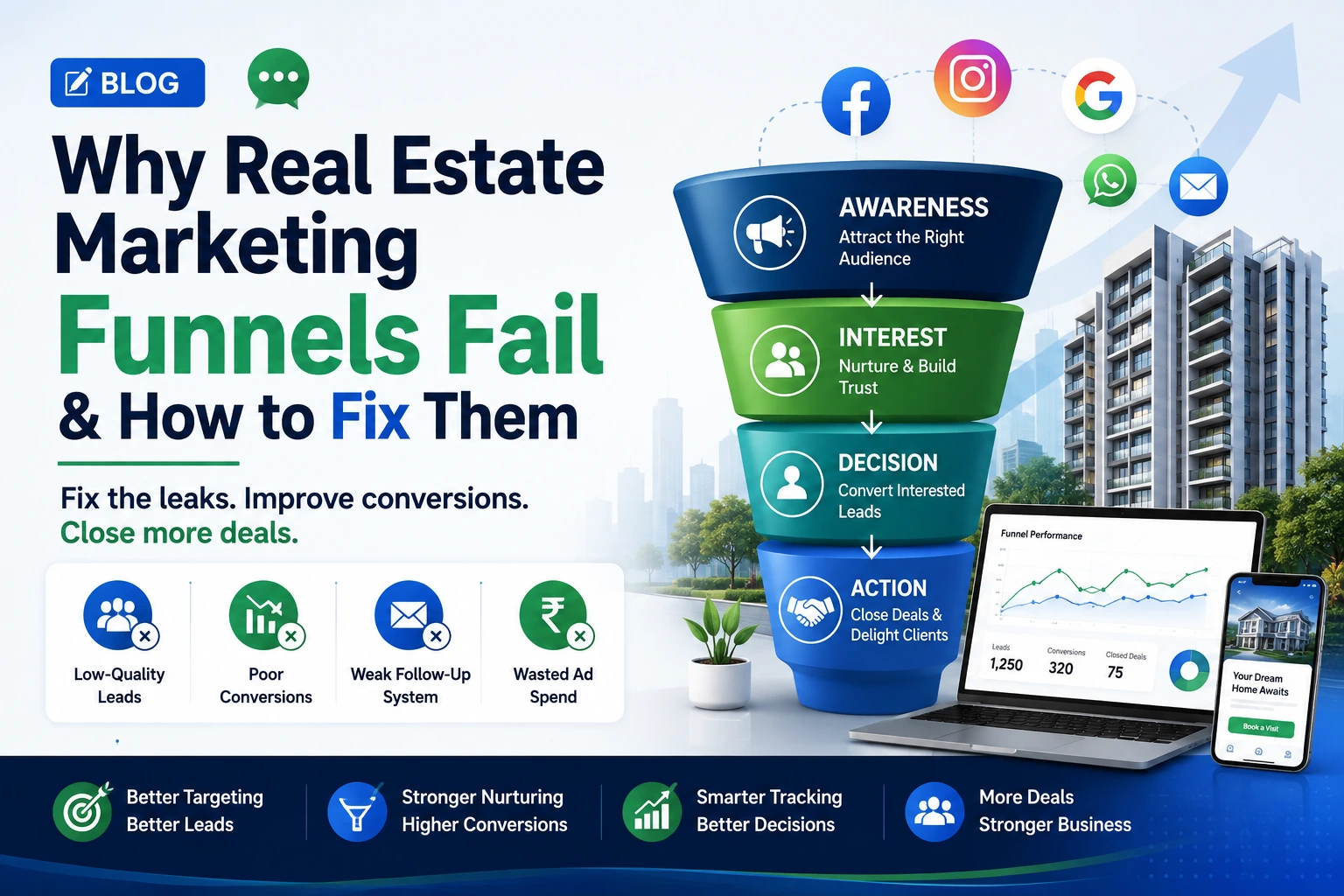
Let's look at this honestly. Most people have poured money into Facebook Ads. They've run Google campaigns, sent drip emails, posted on Instagram, maybe even tried a YouTube channel. And yet, the phone rings with people who "just want to check prices." Buyers who ghost after one tour. Sellers who list with someone else after getting your free service.
If this sounds familiar, you don't have a traffic problem. You have a funnel problem and you're not alone.
Most real estate professionals are sold on the idea that more leads results in more deals. So they chase volume. They optimize for clicks. They celebrate when a lead form gets multiple submissions in a week. That's a weak funnel strategy in disguise, because somewhere between the first form submission and the closing, the funnel quietly bleeds out and no one can explain exactly where or why.
Having worked with and observed hundreds of real estate teams across residential, luxury, and commercial markets, the pattern is almost always the same. The funnel isn't broken because of a bad ad or a weak landing page. It's broken because it was built on the wrong assumption: that more unqualified attention is better than less, qualified interest.
This piece is a direct, honest look at why real estate marketing funnels collapse and what you can actually do about it.
What We've Seen Across Real Estate Funnels
After reviewing campaigns for developers, builders, and independent real estate sales teams, one issue shows up again and again: most businesses focus on generating more enquiries instead of improving lead qualification, response time, and nurturing. Fixing those three areas consistently improves conversion rates usually without spending a single extra rupee on ads.
The Volume Trap: Why Chasing More Leads Is Quietly Killing Your Business
There's a deeply seductive logic to volume-based lead generation. More leads means more chances. More chances means more deals. It feels like math. It feels safe. But real estate is a business built entirely on relationships, timing, and trust and that logic is mostly a trap that costs agents thousands in wasted ad spend and, more importantly, enormous amounts of time.
Here's what actually happens when you prioritize volume over quality:
Your CRM fills up with cold contacts, and your follow-up sequences turn generic
Your team burns out calling people who filled a form at 2 a.m. with no real intention of moving
Your conversion rate quietly drops
Your cost per acquisition quietly rises
The data backs this up. Industry-wide, online real estate leads convert at roughly 2-3% from first inquiry to closed transaction, and portal-sourced leads often convert at less than 1.2%, according to benchmarking compiled from NAR and Real Trends data. Compare that to referral and sphere-of-influence leads, which convert at 14-30% by the same data proof that lead quality moves the needle far more than lead volume ever will.
The real estate industry is particularly vulnerable to the volume trap because lead-generation vendors profit from impressions and clicks, not closings. They have every incentive to sell you "leads" and very little incentive to make sure those leads ever become clients. So the machine keeps spinning, and agents keep feeding it money, hoping this month's batch will be different.
Structural Failures No One Talks About
Volume versus quality is the most visible failure point, but it's not the only one. The real estate marketing funnel has several structural weaknesses that compound each other and if you only fix lead quality without addressing these, conversions will still lag.
1. The Funnel Ends Too Early
Most real estate funnels are built with a single goal: get the appointment. Once a lead books a call or a showing, agents consider the funnel "done." But the funnel doesn't end at the appointment it ends at the closing, and ideally feeds back into referral and repeat business. When agents stop nurturing after the first contact, they lose the majority of leads who were genuinely interested but simply weren't ready yet.
2. The Offer Doesn't Match the Stage of Awareness
A cold prospect who just Googled the worth of a property is not in the same headspace as someone who's already interviewed two other agents. Yet most funnels serve both the same CTA: "Schedule a free consultation." The cold prospect bounces because they're not ready for that level of commitment and you rarely get a second chance to reach them.
3. There's No Real Differentiation in the Funnel
Why should a buyer or seller choose you over the five other agents running nearly identical ads in the same neighborhood? If your funnel can't answer that within the first 30 seconds of engagement, you'll lose most of the people who enter it. Differentiation isn't just about your brand it's about your funnel's ability to communicate a clear, specific, compelling reason to keep paying attention.
4. Tracking Stops at Cost-Per-Lead
Most real estate teams measure what's easy to measure: cost per lead, leads per month, appointments set. Almost none track what actually matters cost per closed transaction by lead source, average nurture time by lead type, or lifetime value by acquisition channel. Without this data, you're optimizing a funnel you can't actually see, and making decisions based on vanity metrics while wondering why revenue doesn't follow.
Weak Funnel vs. Strong Funnel
Weak Funnel | Strong Funnel |
Chases clicks | Qualifies buyers |
Generic landing page for every campaign | Intent-specific landing page per stage |
Stops nurturing after the first enquiry | Nurtures continuously until closing |
Measures cost per lead | Measures cost per closed deal |
One CTA for every visitor | Stage-based CTA matched to buyer intent |
Tracks leads generated | Tracks revenue by source |
How a Healthy Funnel Actually Flows
Ad Click (Meta / Google)
↓
Stage-Specific Landing Page
↓
Qualifying Lead Form
↓
Lead Scoring & Qualification
↓
CRM Entry + Response within 5 Minutes
↓
Automated Nurture (WhatsApp / Email)
↓
Site Visit / Consultation
↓
Booking / Closing
↓
Referral & Repeat Business
Most funnels stop tracking and stop caring right after "Site Visit." The strongest funnels treat everything after the enquiry as seriously as the ad spend that generated it.
7 Real Estate Funnel Mistakes That Quietly Kill Conversions
Buying leads without any qualification step
Slow response time hours instead of minutes
One generic landing page used for every campaign
No automated follow-up via WhatsApp or SMS
No CRM tracking leads through to closing
No retargeting for people who didn't convert the first time
Ignoring the referral stage entirely after a deal closes
Speed alone accounts for a huge share of this gap. Research on lead response behavior has repeatedly found that agents who respond within 5 minutes are dramatically more likely to qualify a lead than those who wait 30 minutes or more yet industry surveys have found average agent response times stretching well beyond an hour, with a meaningful share of inquiries never answered at all.
Real Estate Funnel Audit Checklist
Use this to check whether your current funnel is structurally sound:
[ ] First response happens within 5 minutes of form submission
[ ] Lead form includes a timeline / intent question
[ ] CRM is connected and tracks leads through to closing, not just to appointment
[ ] Meta Pixel and Google Ads conversion tracking are both installed
[ ] WhatsApp or SMS automation is active for follow-up
[ ] Retargeting campaigns run for site visitors who didn't convert
[ ] Funnel performance is reviewed monthly against cost-per-closing, not cost-per-lead
[ ] A referral or repeat-business sequence exists post-closing
How to Repair Your Real Estate Marketing Funnel
Diagnosing the problem is only useful if you're willing to restructure, not just patch. Here's a framework for building a funnel that actually converts grounded in real experience, not theoretical best practices.
Qualify before you capture. Add one or two qualifying questions to your lead form. Ask about their timeline. Ask if they're already working with an agent. Ask what's driving the move. Yes, your lead volume will drop that's the point. The leads that come through will be worth calling, and your team will feel it immediately.
Build stage-specific entry points. Create different lead magnets and landing pages for different levels of intent a first-time homebuyer guide for early-stage prospects, a net proceeds calculator for people getting serious, a free market analysis for those ready to move within 90 days. Match the entry point to the awareness stage and conversion rates climb without any additional spend.
Commit to a 12-month nurture cadence. Most leads aren't ready now, but they will be. Build a follow-up system that provides genuine value over time neighborhood insights, real market data, honest commentary on what's happening in their price range. Be the most informed, most honest voice in their inbox, and when they're ready, they'll call you first.
Differentiate at the offer level. Stop competing on the same generic offers as every other agent. Do you specialize in a specific micro-market? Do you have a proprietary pricing strategy? Do you offer a guaranteed-sale program? Whatever it is, lead with it. Make your funnel tell a story only you can tell.
Track backwards from the closing table. Look at every closed transaction from the last 12 months and identify exactly where that client came from which lead source, which campaign, which content piece. Then double down on the sources that produce closings, not clicks. This single exercise will restructure your marketing budget more effectively than any platform audit.
Humanize your follow-up. A real video text, a personal voicemail, a handwritten note these things feel impossible to scale, but they don't need to scale to work. Even personalizing 20% of your follow-up makes you stand out in a landscape where most competitors send the same automated drip. People buy from people. Let your follow-up remind them that you are one.
None of this is a quick fix. A high-performing real estate marketing funnel is built over months, tested consistently, and refined based on what the data tells you not what the vendor promises. But every element above is within reach of any agent or team willing to step back from the volume treadmill and start building something that actually lasts.
FAQs
Q1: How do I know if my funnel has a lead quality problem or a traffic problem?
Look at your lead-to-appointment rate. If traffic is coming in but fewer than 10-15% of leads ever respond meaningfully, you have a quality problem. If traffic itself is low, that's a reach problem. Most agents assume the latter when it's almost always the former.
Q2: How many real estate leads should an agent manage at one time?
A solo agent can realistically nurture 50-75 active leads well. A team can handle 150-200. Beyond that, the quality of follow-up collapses. It's far better to have 40 well-qualified leads in your CRM than 400 cold contacts nobody wants to call.
Q3: What is the fastest way to improve a real estate marketing funnel?
Add a timeline question to your lead form something as simple as "When are you looking to buy or sell?" It instantly filters browsers from motivated prospects, cuts junk lead volume significantly, and makes every follow-up conversation more focused.
Q4: Is it worth fixing my existing funnel, or should I start from scratch?
Fix first, rebuild later. Audit your last 12 months of closed deals and trace every one back to its lead source. You'll almost always find one or two channels quietly outperforming everything else. Double down on those before touching anything else. Rebuilding from scratch without that data just repeats the same experiment with a fresh coat of paint.