




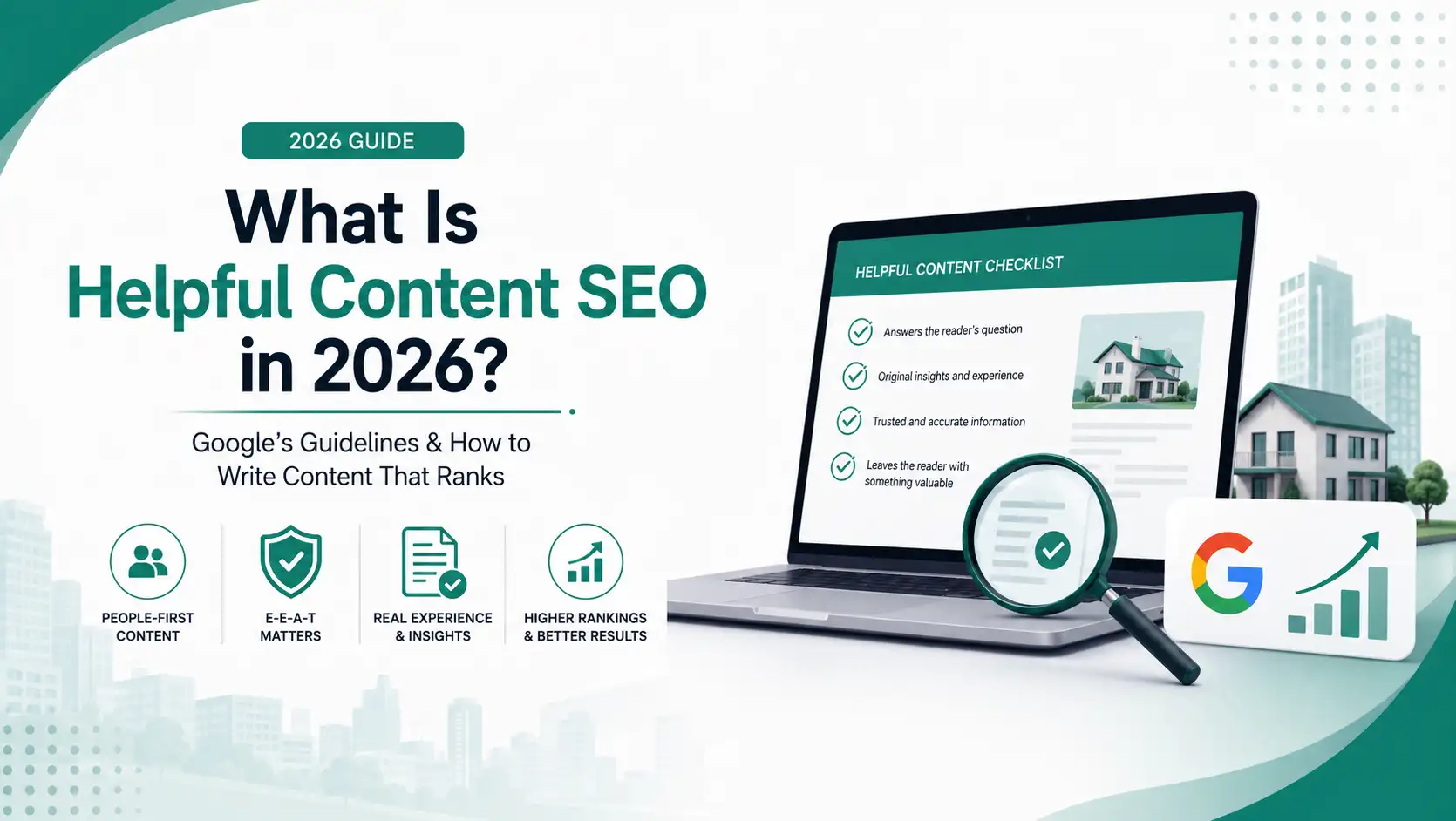
In 2022, Google unveiled the Helpful Content Update (HCU). The purpose of this update wasn't strictly an algorithm change but instead represented Google’s announcement of their dissatisfaction with content written specifically for search purposes. This we also mean things like having too much keyword density (too many keywords in a blog) or too many pages with little useful information (thin landing pages), or AI generated content that says a lot but means very little. Since 2016, Google has continually handed down harsher penalties against mass-produced content due to their helpfulness update. If your real estate website has dropped in rank or has just not ranked at all in these searches, it is likely because of the Helpful Content Updates that Google made that year. This blog post will review how the Helpful Content SEO in 2026 works, how Google finds mass-produced content and will provide an actual use-checklist for landing pages and blog posts on your real estate website.
What Google Actually Means by "Helpful"?
Helpful content's purpose is for the benefit of a real person. If your primary interest in writing an article is to rank it on a search engine rather than providing good information to your readers, your article likely will not get much benefit from better indexing on search engines.
When searching online, the majority of users use search engines to find answers to their needs (e.g., how do I cook this dish?; what is the best car?; does this phone have face recognition?; what are some gift ideas?; how do I get this?). Helpful content provides complete and accurate answers to these questions and also prepares for the user's next question. Users are likely to be very happy with a website when they have found helpful content that allows them to be successful.
Helpful content SEO in 2026 will be:
That answers the question that the reader thought they asked
The reader can find this information somewhere else
The information is from someone with authentic experience or knowledge of the topic, and not someone who found a source of existing content and put it all together
Leaves the reader with something to do as a result of reading the material
This is called by Google a People First Content Strategy, where the content is for the reader first, and search engine visibility is a benefit of producing this material versus the starting point. The reverse is called poor writing where you choose a keyword for a post then write a blog post around the keyword. It is also possible to optimise headings, meta descriptions, & word count. In the end, you will have something that is technically correct but has no substance to the reader.
Google's algorithm in 2026 will be able to tell the difference between these two types of content. Implementing a People First Content Strategy will soon become the baseline to obtain a good ranking in search engines.
How Google Detects "Thought-Through" vs Mass-Produced Content ?
“How will Google know whether a score of articles was produced by a human being who is an expert in their field?” is a question many digital marketers and writers have asked this year. In the year 2026, Google will judge how “human and qualified” or “AI-generated” based on its E-E-A-T Standards or Guidelines (Experience, Expertise, Authoritativeness, Trustworthiness).
The first criteria Google will use is Experience, which consists of whether your content is based solely on your personal event. An example would be a real estate agent’s description of your house sale.
The second criteria is Expertise in that the information must not be just educational, but rather it must be detailed; if an expert wrote it, then it would have specific insights that an expert would possess.
The next criterion is that Authoritativeness must exist on the part of the resource providing the information over and above who they are writing it for; this includes items such as author biography, level of trust with the brand producing the information, and the presence of backlinks to more highly regarded locations.
The fourth criteria is that Trustworthy information is defined as free of false, misleading, or otherwise self-serving information; the author must also have sufficient credentials for their assertions.
Google has clearly stated that helpful content on AI-generated articles is not systematically penalised, nor is AI-generated content simply produced or poor quality; rather, AI-generated content must be produced in a manner or environment whereby it was created by a qualified individual who provided some level of quality assurance for the article prior to its production.
What This Means for SEO Content Writing in 2026?
As we enter 2026, SEO content writing looks completely different than what it did in 2020. The formula to produce SEO content has been modified to meet the expectations of Google’s systems. Although the following still exist, ranking will not happen unless content passes five tests under Google’s methodology.
What existed in 2020 as a minimum of 1500 words with internal links with the target keyword in the title (H1) with a well-optimised meta description still apply but alone will no longer guarantee you a ranking.
The five criteria that must now be met to provide content for consumers include:
Originality: Does the content provided contain information that has not been published verbatim on 40 other websites? (Example, these items consistently indicate real effort:
- Original Analyses,
- Original Data, and/or
- Original Opinion
Specificity: Generalised advice about “locations matter” in real estate would rank lower than providing specific information about real estate in an area – (Example, for the area of Sector 65 of Gurgaon where possession-ready inventory decreased 18% in Q1 2024 – here's how that will impact your timeline to purchase).
Indicators of reader satisfaction: Time spent on page, scroll depth, return visits, low bounce rate these items indicate that the expected satisfaction from the content was met.
A people-first content strategy in 2026 means that your content must meet the one-to-one test at your point before publication:
Would this content benefit the person searching for this content?
If the answer is “no” you must rewrite it or do not publish it.
This is the essence of what Google calls your helpful content checklist.