




A Gurgaon developer spent ₹8 lakh on a Meta retargeting campaign last quarter. The ROAS looked strong until an iOS update quietly cut the campaign's tracked conversion rate by 30%. Leads were still coming in. The developer just couldn't prove where most of them came from anymore.
This isn't an isolated glitch. It's the new normal for real estate marketing in India, and it's about to get worse for anyone who hasn't started building their own data.
Why Retargeting Is Breaking for Indian Real Estate
Retargeting has long been the backbone of property marketing in India. A buyer visits a project microsite, and for the next 30 days, that person is followed by ads across news sites, YouTube, and Gmail all powered by third-party cookies quietly tracking behavior across the web.
That backbone is being pulled out from under the industry, and fast:
Google's Privacy Sandbox is phasing out third-party cookies across Chrome, which alone holds roughly 95% of India's browser market share.
Apple's App Tracking Transparency (iOS 14.5+) has already gutted Meta's ability to track and attribute conversions on iPhones the exact device segment that tends to convert on higher-ticket real estate leads.
Developers running lead-gen campaigns are seeing leads continue to arrive, but attribution data collapsing making it nearly impossible to tell which channel, creative, or campaign actually drove the sale.
The takeaway for Indian real estate brands is blunt: any marketing plan still leaning on third-party tracking as its foundation is standing on borrowed time.
What's Actually Changing (And Why It's Permanent)
This isn't a temporary platform hiccup it's a structural shift with two forces pushing in the same direction:
Platform-side privacy changes. Google and Apple are both restricting cross-site tracking at the browser and OS level, not just adjusting ad settings.
Regulation. India's Digital Personal Data Protection (DPDP) Act requires explicit, informed consent before personal data is collected which directly affects how leads can be captured, stored, and remarketed to.
Neither of these trends is reversing. The practical response isn't to replace retargeting it's to make it independent of third-party platforms entirely, by building an owned data foundation.
What First-Party Data Looks Like in Real Estate
First-party data is any information you collect directly from buyers, sellers, and renters through channels you own your website, CRM, app, or an open house sign-in sheet rather than data rented from an ad platform or third-party broker.
Data Type | What It Captures | Where It's Collected |
Contact Details | Name, phone, email, current address | Lead forms, conversion pages |
Behavioral Data | Time on listing pages, virtual tour views, saved searches | Website / app analytics |
CRM Data | Transaction records, call logs, site-visit notes | CRM, open houses, property tours |
Email & SMS Engagement | Opens, clicks, replies on market updates | Email/SMS platforms |
Preference Data | "3BHK near schools," budget, pre-approval status | Surveys, lead-qualification forms |
An agent or developer sitting on this kind of data can build far more precise, personalized campaigns than any third-party audience segment could ever offer and none of it disappears when Apple or Google changes a policy.
How Real Estate Companies Collect First-Party Data
The best first-party data strategies don't feel like data collection to the buyer they feel like a useful tool exchanged for a small amount of information.
Valuation & Mortgage Tools – Visitors trade contact and property details for an instant home-value estimate or EMI calculator.
Property Portals & Apps – Saved listings, likes, and search history reveal exactly which neighborhoods, price points, and property types a buyer is serious about.
Virtual & In-Person Tours – Sign-in sheets at open houses and virtual tour forms confirm buyer identity and intent.
Lead Magnets – Gated content like "First-Time Homebuyer Guides" or local market reports in exchange for an email address.
Interactive Chatbots – Real-time qualification ("When are you moving? What's your budget?") that captures structured intent data as the conversation happens.
Email Newsletters – Click and open-rate tracking reveals which property types or market updates a subscriber actually cares about.
Third Party vs First-Party: A Quick Comparison
Third-Party Data | First-Party Data | |
Ownership | Rented from ad platforms/brokers | Owned by your business |
Reliability post-iOS/cookie changes | Degrading fast | Unaffected |
DPDP Act compliance | High risk if unconsented | Built on explicit consent |
Targeting precision | Broad, platform-defined segments | Buyer-specific intent signals |
Long-term cost | Rising as inventory shrinks | One-time investment, compounding value |
Building a Cookieless Marketing Strategy That Actually Converts
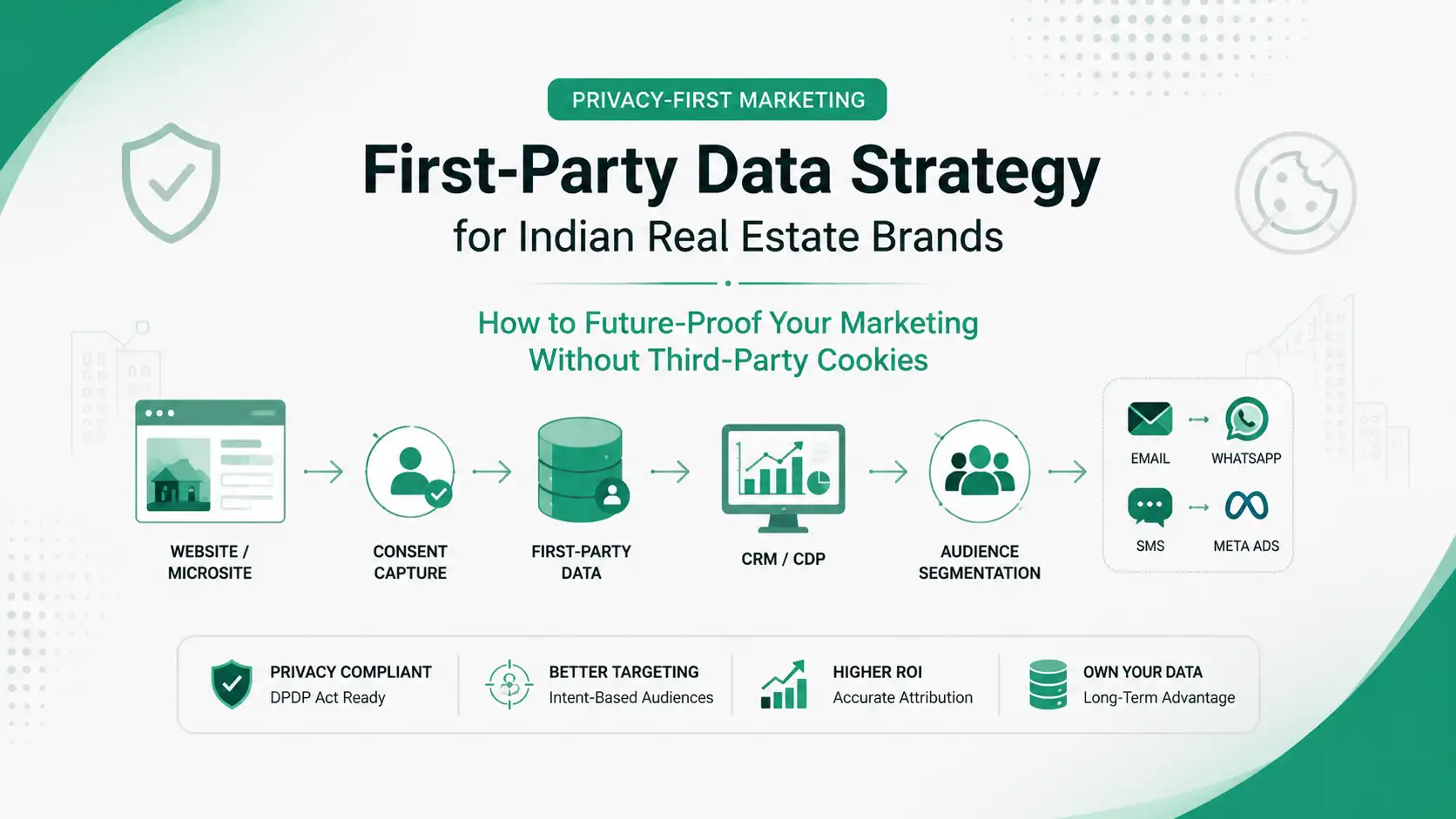
A first-party data strategy for Indian real estate in 2026 comes down to three moves:
Own the collection layer. Put a valuation tool, mortgage calculator, or lead magnet on every property microsite don't rely solely on a contact form.
Centralize it. Feed every touchpoint website, WhatsApp, CRM, site visits into one CRM so buyer intent isn't scattered across five disconnected tools.
Activate it independently of third parties. Use your own list for retargeting via email/SMS/WhatsApp, and feed consented first-party data into platforms like Meta Custom Audiences instead of depending on their cookie-based tracking.
Delaying this doesn't just mean weaker campaigns next quarter it means starting from zero later, while competitors who began building their list today already have 12+ months of buyer data to work with.
FAQ
Q. What is first-party data in real estate marketing?
It's information collected directly from buyers, sellers, and renters through channels you own your website, CRM, app, or in-person interactions rather than data purchased or borrowed from third-party ad platforms.
Q.Why is third-party cookie deprecation such a big deal for Indian developers?
Because retargeting the core of most property lead-gen campaigns has historically depended on third-party cookies to follow buyers across the web. As Chrome (roughly 95% of India's browser market) and iOS restrict this tracking, attribution and targeting accuracy both decline sharply.
Q. Does the DPDP Act affect how real estate companies can retarget leads?
Yes. The DPDP Act requires explicit, informed consent before personal data is collected or used for marketing, which makes a properly consented first-party data system both a compliance requirement and a competitive advantage.
Q. How long does it take to build a usable first-party data asset?
Most brands need several months of consistent collection across microsites, CRM, and lead magnets before the data set is large enough to power meaningful segmentation and lookalike targeting which is why starting early matters more than starting perfectly.