




Have you ever wondered why some leads become customers while others disappear without ever buying?
Generating leads is only half the battle. The real challenge most businesses face is figuring out which leads are actually qualified leads and which ones are unlikely to convert. Not every person who downloads an eBook, signs up for a newsletter, or visits your website is ready to buy. Some are just researching. Others are browsing and may never convert at all.
This is exactly where lead scoring comes in.
A strong lead scoring model helps businesses identify which prospects are genuinely interested, so sales teams can focus their time on high-intent buyers instead of chasing dead ends. In today's competitive landscape, companies that prioritize the right leads close deals faster, improve conversion rates, and build tighter coordination between sales and marketing than those that treat every lead the same. Industry research has also linked structured lead scoring to measurably higher qualified-lead volume and stronger ROI for marketing teams that adopt it, more on that later.
In this guide, we'll break down exactly how lead scoring works, why it matters, the difference between MQLs and SQLs, and how to build a practical scoring system that improves lead qualification and revenue growth.
What Is Lead Scoring?
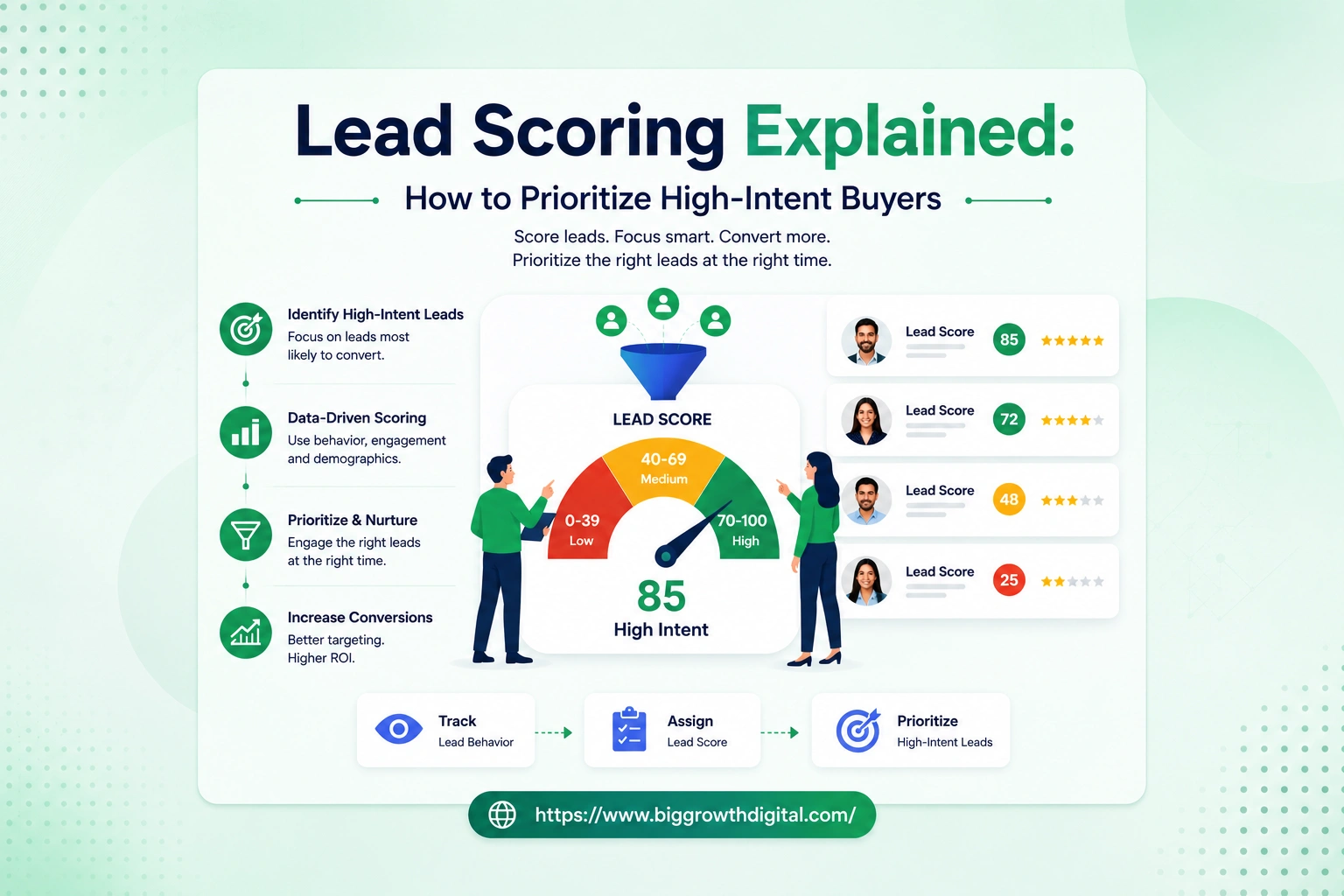
Lead scoring is a framework used to rank and prioritize leads based on how likely they are to become paying customers. It's an objective ranking of one sales lead against another, helping marketing and sales teams align on where each prospect sits in the buying journey, rather than relying on gut feeling.
Businesses assign numerical or quantitative values to leads based on: Who they are (demographic and firmographic fit) What actions they take (behavioral engagement) How engaged they are with the brand over time
The higher the score, the greater the likelihood of conversion. A CEO requesting a demo might receive a very high score. A student downloading a free guide might receive a much lower one. This lets businesses focus limited sales resources on the prospects most likely to generate revenue, instead of treating every lead identically.
Why Lead Scoring Matters
Without proper lead qualification, sales reps often waste time chasing leads that were never going to buy. This creates a familiar set of problems: lower productivity, slower sales cycles, poor conversion rates, and friction between sales and marketing teams. Sales reps typically spend a meaningful share of their week just researching and prioritizing prospects, time that a good scoring system gives back.
Lead scoring solves this by creating a clear, shared system for prioritization. Marketing can focus on nurturing early-stage leads, while sales focuses on prospects that show real buyer intent. This becomes especially critical in B2B lead scoring, where buying decisions involve multiple stakeholders and longer cycles.
Done correctly, lead scoring helps businesses: Improve sales efficiency and shorten sales cycles Increase conversion rates Reduce customer acquisition costs Strengthen sales and marketing alignment Identify high-intent buyers faster, before competitors do
Explicit vs Implicit Data: The Foundation of Lead Scoring
Every lead scoring model rests on two types of data:
Explicit (fit) data is information directly provided by or about the lead, job title, company size, industry, location, budget, and role in the decision-making process. This defines whether a lead matches your Ideal Customer Profile (ICP).
Implicit (behavioral) data is based on observed actions, page visits, content downloads, email opens, demo requests, rather than stated information. This reveals actual buyer intent, since actions often say more than demographics alone.
A third category worth building in from day one: spam or negative data, information from fake form submissions, junk emails, or disqualifying signals, which should be filtered out or scored negatively rather than ignored.
The Core Components of a Lead Scoring Model
1. Fit or Demographic Scoring
Demographic scoring measures whether a lead matches your ICP, regardless of how engaged they seem. Even a highly engaged visitor may simply not be the right customer for your business.
Common fit scoring factors include job title, industry, company size, location, revenue size, and decision-making authority.
Example: A marketing director at a SaaS company matching your ICP might score +20 points. A freelancer outside your target market, even if mildly interested, might score only +5 points. Fit scoring keeps your team focused on leads that actually match who you sell to.
2. Behavioral or Engagement Scoring
Behavioral scoring tracks what users actually do, widely considered one of the strongest indicators of genuine buying intent, since actions reveal more than self-reported data.
High-value actions typically include visiting pricing pages, booking a demo, downloading case studies, watching product videos, and attending webinars.
Example point structure: Opening an email: +2 points Visiting a pricing page: +10 points Requesting a demo: +30 points
3. Company or Firmographic Scoring
For B2B specifically, company-level scoring looks at firmographic data like industry vertical, company size, and growth stage, separate from the individual contact's personal fit or behavior.
4. Combined (Fit + Engagement) Scoring
Most mature lead scoring models combine fit and engagement into a single view. Fit is typically scored on a letter scale (A to D, with A being the best match), and engagement on a numeric scale (1 to 4, with 1 being most engaged). Combining them creates a matrix, an A1 lead (great fit, highly engaged) is your top priority; a D4 lead (poor fit, low engagement) usually isn't worth sales time at all.
Manual Lead Scoring vs Predictive Lead Scoring
Factor | Manual Lead Scoring | Predictive Lead Scoring |
|---|---|---|
How it works | Points assigned manually based on gathered data | AI/machine learning analyzes historical conversion patterns |
Setup effort | Simpler to start, labor-intensive to maintain | More setup, but scales automatically |
Accuracy | Prone to human error and bias | Improves as more data flows in |
Scalability | Harder to scale with lead volume | Scales naturally with lead and data volume |
Best for | Small teams, early-stage scoring | Growing teams with sufficient historical conversion data |
Update frequency | Manual review, usually quarterly | Often refreshes automatically every few hours |
Predictive lead scoring typically requires a reasonable sample of both converted and non-converted contacts to train the model accurately, too little data and the predictions won't hold up.
How to Build a Lead Scoring Model in 5 Steps
Step 1: Define Your Ideal Customer Profile (ICP)
Study your existing best customers before building any scoring rules. Work with sales and marketing together to identify: which industries convert most, which job titles usually make the purchasing decision, and which company sizes generate the highest revenue. This becomes the foundation for accurate lead qualification.
Step 2: Calculate Your Baseline Conversion Rate
Before assigning point values, know your starting point. Use this formula:
(Number of leads converted to customers) ÷ (Total number of leads generated) × 100
If you convert 100 customers out of 200 leads, your baseline lead-to-customer conversion rate is 50%. Every scoring rule you build afterward gets measured against this baseline.
Step 3: Assign Scores to High-Intent Actions
Not every action carries equal weight. Reading a blog post shows light interest and should score low. Visiting a pricing page or requesting a demo signals real purchase intent and should score much higher.
Example model: Blog visit: +2 points (shows basic interest) Pricing page visit: +10 points (evaluating cost/fit) Demo request: +30 points (strong purchase intent)
Step 4: Compare Close Rates by Attribute Against Baseline
For each behavior or demographic attribute, calculate its individual close rate and compare it to your overall baseline. Attributes with close rates meaningfully above baseline deserve higher point values; those at or below baseline should be scored low or not at all.
Step 5: Set MQL and SQL Thresholds and Automate
Define clear score ranges for Marketing Qualified Leads (MQLs) and Sales Qualified Leads (SQLs), then automate scoring inside your CRM or marketing automation platform so scores update in real time as leads engage.
MQL vs SQL: Setting Clear Thresholds
MQL (Marketing Qualified Lead) | SQL (Sales Qualified Lead) | |
|---|---|---|
Definition | Engaged by marketing efforts, shows interest but needs nurturing | Vetted by sales, shows budget, need, and readiness for outreach |
Typical score range (example) | 40+ points | 70+ points |
Next action | Continue nurturing | Direct sales follow-up |
Represents | Early interest | Actionable buying intent |
A lead scoring 40 points might be classified as an MQL, showing moderate interest but not yet ready for a sales conversation. A lead scoring 70 points becomes an SQL, indicating serious purchase consideration. Clear thresholds improve communication between teams and speed up follow-up on high-value leads. Many teams also define a service-level agreement here, for example, following up with top-tier leads within 24 hours and lower-tier qualified leads within 48 hours.
Score Decay: Why Old Engagement Shouldn't Count Forever
Buyer intent isn't static, it fades. That's why score decay matters in any serious lead scoring model.
If a lead goes quiet for 30 days, their score might automatically drop by a set percentage, commonly seen decay structures reduce an event's point contribution by a fixed percentage each month until it eventually contributes nothing. This prevents outdated activity from making a stale lead look more valuable than it actually is, so sales teams focus on currently active, genuinely interested prospects instead of chasing cold history.
Negative Lead Scoring
Most businesses focus only on adding points and forget to subtract them. Negative lead scoring deducts points for disqualifying signals, a lead using a generic personal email address to download gated content, a lead located outside your service area, or a lead who unsubscribes from your newsletter. Building this in early creates a more realistic model and stops sales from wasting time on leads that look active but were never going to convert.
Lead Scoring Software and CRM Integration
Manual lead tracking becomes unmanageable as lead volume grows. Modern CRM and marketing automation tools (Salesforce, HubSpot, Zoho CRM) can track behavior, update scores in real time, notify sales instantly, and trigger automated nurture campaigns.
Look for lead scoring software that supports: Engagement scores (based on actions like page visits, CTA clicks, email opens) Fit scores (based on demographic/firmographic property values) Combined scores that merge both into a single prioritization view Score thresholds with color-coded categories (e.g., High/Medium/Low, or lettered tiers like A1–C3) so reps can instantly spot top leads AI-powered predictive scoring for teams with enough historical conversion data to train a model accurately
CRM integration also matters beyond scoring itself, syncing leads captured from Facebook, LinkedIn, TikTok, or Google Lead Ads directly into your CRM ensures scoring criteria apply immediately, without manual data entry delays.
Best Practices for Effective Lead Prioritization
Regularly audit your scoring model. Buying behavior and market conditions shift constantly. Review scoring rules on a quarterly basis to see which leads converted, which were rejected, and which actions actually predicted revenue.
Align sales and marketing on definitions. Lead scoring only works when both teams agree on what qualifies as an MQL, when a lead becomes an SQL, and how quickly leads should be followed up on.
Focus on intent over vanity metrics. Email opens are weak signals. Pricing page visits are stronger. Demo requests are extremely strong. Weight your model accordingly.
Keep the model simple at first. Too many scoring criteria make the system difficult to manage and interpret. Start narrow, then expand as you gather more conversion data.
Consider account-level and opportunity-level scoring as you mature. Beyond individual contact scoring, more advanced teams apply similar logic to account-based marketing (ABM), scoring entire accounts or specific deal opportunities based on the same fit-plus-engagement logic.
Common Lead Scoring Mistakes to Avoid
Overcomplicating the model with too many scoring rules that become impossible to manage or interpret. Failing to lower scores for inactive or unqualified leads, letting stale data inflate scores. Assuming ICP match alone guarantees buying intent, fit without engagement isn't enough. Using only one customer segment as your business scales into new products or markets. Not updating or refining the model regularly as customer behavior and market trends shift. Relying on stale data to train predictive models, feeding AI tools outdated information for both converted and non-converted leads undermines accuracy. Skipping negative lead scoring entirely, treating every engaged lead as equally valuable regardless of quality.
Final Takeaways
In a competitive market, businesses can no longer afford to treat every lead the same way. Some leads are genuinely not worth pursuing; others are high-potential buyers ready to convert. A strong lead scoring strategy helps identify high-intent buyers, improves lead qualification, and helps sales and marketing work more efficiently by focusing on the leads that matter most.
Lead scoring is not a one-time setup. It needs regular auditing, sales-marketing alignment, and clean, current data to stay accurate as your business and your buyers evolve.
FAQs
Q. What is lead scoring in simple terms?
Lead scoring is a system that assigns point values to leads based on their demographics and behavior, helping sales teams identify and prioritize which prospects are most likely to convert.
Q. How do you calculate a lead score?
Assign point values to demographic attributes (fit) and behavioral actions (engagement) based on how strongly each correlates with past conversions, then sum them into a total score, often compared against your baseline conversion rate.
Q. Can you give an example of lead scoring?
A lead who visits your pricing page (+10), opens two emails (+4), and requests a demo (+30) would score 44 points total, likely placing them in MQL or SQL range depending on your thresholds.
Q.What is the difference between lead grading and lead scoring?
Lead scoring typically measures overall likelihood to convert using a single numeric value. Lead grading specifically evaluates fit against your ICP using a letter scale (A–D), often used alongside a numeric engagement score in combined models.
Q. What is BANT in lead qualification?
BANT stands for Budget, Authority, Need, and Timeline, a traditional framework for qualifying whether a lead is truly ready to buy, still used but increasingly supplemented by behavioral data since buyers now research long before budget or timeline are defined.
Q. What's the difference between MQL and SQL? An MQL (Marketing Qualified Lead) shows engagement and interest but still needs nurturing. An SQL (Sales Qualified Lead) has been vetted by sales as having budget, need, and readiness for direct outreach.
Q. What is predictive lead scoring?
Predictive lead scoring uses AI and machine learning to analyze historical lead data and automatically identify patterns that predict conversion, updating scores dynamically as new data comes in, more scalable than manual scoring.
Q. What is negative lead scoring?
Negative lead scoring subtracts points for disqualifying signals, like using a personal email domain, being located outside your service area, or unsubscribing, helping avoid wasted effort on low-quality leads.
Q. How often should a lead scoring model be updated?
Most teams review and refine their scoring model quarterly, though predictive/AI-based models can refresh automatically every few hours as new data comes in
Q. Does lead scoring require a CRM?
Not strictly, small teams can start with manual scoring in a spreadsheet, but a CRM with built-in scoring functionality (like Salesforce or HubSpot) makes real-time tracking, automation, and scaling far more practical.
Q. What is score decay in lead scoring?
Score decay automatically reduces a lead's score over time if they stop engaging, preventing outdated activity from making an inactive lead look more valuable than they currently are.
Q. Is lead scoring only for B2B businesses?
No, though it's especially critical in B2B lead scoring due to longer sales cycles and multiple stakeholders, B2C businesses with considered purchases (real estate, high-ticket products) also benefit significantly from prioritizing high-intent buyers.
Q. What's the difference between demographic scoring and behavioral scoring?
Demographic scoring measures whether a lead fits your ideal customer profile based on stated attributes like job title or company size. Behavioral scoring measures what a lead actually does, page visits, downloads, demo requests, which often more accurately reflects real buying intent.